
Dinosaurs first emerged during the late Triassic Period, approximately 245 to 230 million years ago. At this time, Earth was a much different place—dominated by a single supercontinent called Pangaea and a warm, dry climate. Early dinosaurs like Eoraptor and Herrerasaurus were small, bipedal, and relatively fast predators. The earliest dinosaurs were not yet the dominant animals; they competed with other reptiles and early mammal-like creatures for ecological space.
Rise of Giants in the Jurassic Period
Moving into the Jurassic Period, around 201 to 145 million years ago, dinosaurs underwent massive diversification. This was a time of evolutionary experimentation. The supercontinent began to break apart, creating more coastlines and varied environments. This shift enabled the evolution of larger herbivorous dinosaurs like Brachiosaurus and Diplodocus, as well as powerful predators like Allosaurus.
The Jurassic saw the rise of sauropods—long-necked dinosaurs that would become some of the largest animals to ever walk the Earth. It also marked the early evolution of bird-like theropods, setting the stage for future avian species.
Peak of Dinosaur Diversity in the Cretaceous Period
The Cretaceous Period, lasting from 145 to 66 million years ago, was the final and most dynamic chapter in the age of dinosaurs. This period witnessed the highest diversity in dinosaur species, ranging from the heavily armored Ankylosaurus to the towering Tyrannosaurus rex and the agile, intelligent Velociraptor.
Flowering plants emerged during this time, altering ecosystems and feeding behaviors. Dinosaurs adapted to these environmental changes in remarkable ways, leading to specialized feeding strategies and new forms of locomotion.
This era also introduced the first true birds, evolved from small theropod dinosaurs. Feathers became increasingly common, supporting theories about insulation and display behaviors well before powered flight became a widespread trait.
Continental Drift and Changing Climates
Throughout the Mesozoic Era—the umbrella era covering the Triassic, Jurassic, and Cretaceous—continental drift and shifting climates played crucial roles in dinosaur evolution. The movement of land masses created isolation and new habitats, leading to adaptive radiation and speciation. Dinosaurs in South America developed differently than those in Asia or North America due to long-term geographic separation.
Climate changes also had a continuous impact. From lush, tropical environments to arid deserts and cooler highlands, dinosaurs had to adapt or perish. This evolutionary pressure drove physical adaptations such as thick skin, heat-regulating crests, and dietary specializations.
The Cataclysmic End: The Cretaceous-Paleogene Extinction
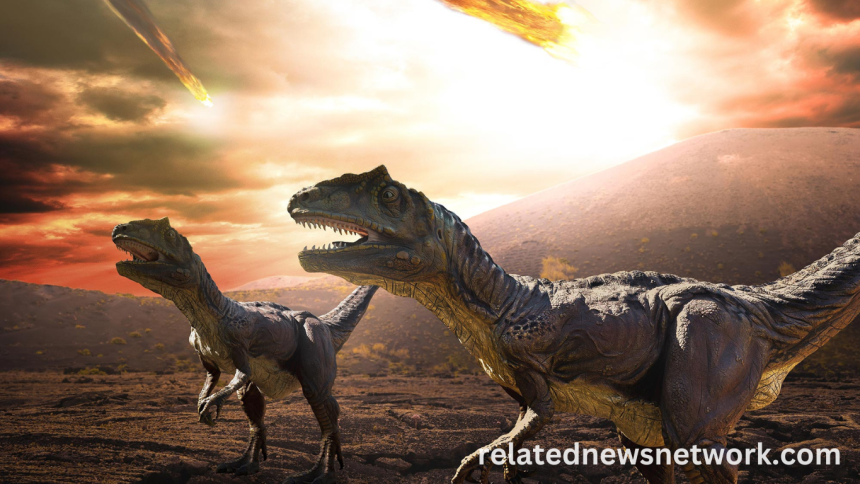
Around 66 million years ago, a sudden and catastrophic event marked the end of the age of dinosaurs. A massive asteroid impact, striking what is now the Yucatán Peninsula in Mexico, created the Chicxulub Crater. The impact released energy equivalent to billions of nuclear bombs and triggered widespread fires, tsunamis, and a “nuclear winter” scenario.
Global temperatures plummeted, photosynthesis stopped in many regions, and food chains collapsed. While some life forms managed to survive, non-avian dinosaurs vanished entirely. Only their avian descendants—early birds—endured and continued evolving.
Read More : What Is the Lost Empire Of Tartaria?
Total Duration of Dinosaur Reign on Earth
Dinosaurs ruled the Earth for an astonishing approximately 180 million years, far longer than humans have existed. From their origins in the late Triassic to their sudden extinction at the end of the Cretaceous, they adapted to shifting continents, fluctuating climates, and changing ecosystems with remarkable success.
Their reign covered nearly half of the Phanerozoic Eon, an era known for visible life and complex organisms. For perspective, Homo sapiens have only been around for about 300,000 years—a mere fraction of the time dinosaurs dominated.
Legacy in Modern Times
Although non-avian dinosaurs are extinct, their legacy endures. Birds, their direct descendants, serve as living reminders of their evolutionary success. Scientific research continues to uncover connections between ancient dinosaurs and modern species, including shared genetic markers, nesting behaviors, and even respiratory systems.
The fossil record also provides critical insights into extinction events, ecosystem shifts, and planetary evolution. Dinosaurs remain one of the most studied and iconic groups in paleontology, captivating imaginations and deepening understanding of Earth’s deep past.
Frequently Asked Questions
When did dinosaurs first appear on Earth?
Dinosaurs first appeared around 245 to 230 million years ago during the late Triassic Period.
How long did dinosaurs live on Earth?
Dinosaurs ruled the Earth for approximately 180 million years before going extinct around 66 million years ago.
What caused the extinction of dinosaurs?
A massive asteroid impact, along with volcanic activity and climate change, caused a mass extinction event.
Did all dinosaurs go extinct?
Not all—avian dinosaurs (early birds) survived and evolved into the birds we see today.
Which was the largest dinosaur ever discovered?
Argentinosaurus, a massive sauropod, is believed to be the largest dinosaur, measuring over 100 feet long.
What was the smartest dinosaur?
Troodon is often considered among the smartest dinosaurs due to its relatively large brain-to-body ratio.
Where have most dinosaur fossils been found?
Dinosaur fossils have been discovered on every continent, with significant finds in North America, Asia, and South America.
Are there any living relatives of dinosaurs today?
Yes, birds are direct descendants of theropod dinosaurs and are considered their modern-day relatives.
Conclusion
Dinosaurs roamed Earth for nearly 180 million years, adapting to dramatic shifts in environment, geography, and ecosystems. Their sudden extinction marked the end of an era but also gave rise to mammals and, eventually, humans. Their fossil legacy continues to inform science and inspire discovery, revealing the complex and awe-inspiring history of life on our planet.