
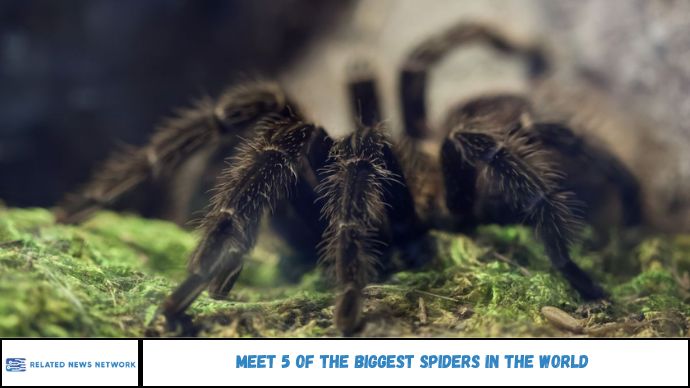
Nature’s Eight-Legged Giants
Ever heard footsteps in the jungle and thought it was a small animal—only to realize it was a spider?
Some spiders are large enough to trigger your primal fear response. But these massive arachnids are more than creepy crawlies—they’re biological marvels.
For a time, it was believed to be the largest spider to ever crawl the Earth. Scientists in Argentina were thrilled when they unearthed the fossil of a massive creature they named Megarachne—a title straight out of a sci-fi thriller.
Though it wasn’t quite big enough to battle Godzilla, it was still the stuff of nightmares. The fossil, estimated to be 300 million years old, showed a creature with a leg span of nearly 20 inches and a body stretching up to 21 inches—far from anything you’d want lurking beneath your bed.
But the plot twist came in the early 2000s, when researchers confirmed that Megarachne wasn’t a spider at all—it was actually a species of extinct sea scorpion. Fossil records now suggest that prehistoric spiders were never that massive.
That said, nature didn’t leave us empty-handed. Today, there are real-life giant spiders crawling across the planet—larger than dinner plates, bigger than some pets, and definitely big enough to give you chills if one decided to cozy up next to you.
Abstract
Biggest spiders in the world fascinate and terrify in equal measure. This guide explores five massive spider species, detailing their size, habitat, and unique traits. Understand what makes them the largest, and why they play a key role in the ecosystem.
1. Goliath Birdeater (Theraphosa blondi)
Claim to Fame: World’s heaviest spider
- Leg Span: Up to 11 inches (28 cm)
- Weight: Over 6 oz (170 grams)
- Habitat: Rainforests of northern South America
- Interesting Fact: Despite its name, it rarely eats birds.
The Goliath Birdeater is not just big—it’s hefty. It uses powerful fangs to hunt worms, insects, and sometimes small mammals. Its thick body and bristle-covered legs make it look even larger.
2. Giant Huntsman Spider (Heteropoda maxima)
Claim to Fame: Longest leg span of any spider
- Leg Span: Up to 12 inches (30 cm)
- Habitat: Caves in Laos
- Interesting Fact: Discovered only in 2001
This cave-dwelling species looks straight out of a nightmare. It doesn’t spin webs but relies on speed and agility to catch prey. Its long legs give it a crab-like scuttle.
3. Brazilian Salmon Pink Birdeater (Lasiodora parahybana)
Claim to Fame: Second-heaviest tarantula
- Leg Span: Up to 10 inches (25 cm)
- Weight: Around 5.5 oz (155 grams)
- Habitat: Eastern Brazil
- Interesting Fact: Popular in the exotic pet trade.
Known for its vibrant pink hairs, this spider may look flamboyant, but it packs a punch. It’s fast-growing and often used in tarantula breeding programs.
4. Colombian Giant Tarantula (Megaphobema robustum)
Claim to Fame: Robust and intimidating appearance
- Leg Span: Up to 8 inches (20 cm)
- Habitat: Tropical forests of Colombia and Brazil
- Interesting Fact: It uses its spiny back legs for defense.
This tarantula may not top the charts in size, but its thick limbs and defensive behavior make it a formidable spider. It often uses intimidation rather than attack.
5. Camel Spider (Solifugae – not a true spider)
Claim to Fame: One of the most misunderstood arachnids
- Leg Span: Up to 6 inches (15 cm)
- Habitat: Deserts in the Middle East, Africa, and the Americas
- Interesting Fact: Can run up to 10 mph (16 km/h)
Though not a true spider, camel spiders earn their spot for size and speed. They’re known for their large jaws and intimidating presence. Contrary to myths, they don’t eat camels or humans.
Why Do These Spiders Grow So Large?
Several factors contribute to a spider’s size:
- Climate and environment (e.g., tropical rainforests)
- Diet and food supply
- Evolutionary adaptations for predation and defense
Large size often allows spiders to dominate their ecological niches.
Are They Dangerous to Humans?
Despite their intimidating appearance:
- Most large spiders are not deadly to humans.
- They bite only in self-defense and prefer to flee.
- Their venom is usually mild, comparable to a bee sting.
The real danger lies in the fear factor, not the bite itself.
FAQs
1. What is the biggest spider in the world?
The Goliath Birdeater holds the title for the heaviest spider globally.
2. Which spider has the longest legs?
The Giant Huntsman Spider has the longest leg span, up to 12 inches.
3. Are big spiders more venomous?
Not necessarily. Larger spiders often rely on size rather than potent venom.
4. Can any of these spiders kill humans?
No. None of the top five are fatal to humans, though bites can be painful.
5. Where can I see these spiders?
Many are found in South American jungles or captive environments like zoos.
6. Can I keep one as a pet?
Yes, species like the Salmon Pink Birdeater are common in exotic pet collections.
Conclusion
The biggest spiders in the world continue to fascinate scientists and thrill-seekers alike. Whether it’s the weight of the Goliath Birdeater or the leg span of the Giant Huntsman, these arachnids are proof of nature’s extremes.
Understanding them not only dispels myths but reveals the important roles these giants play in ecosystems. So, next time you see a big spider, take a second look—you might just be witnessing one of nature’s most remarkable creatures.