
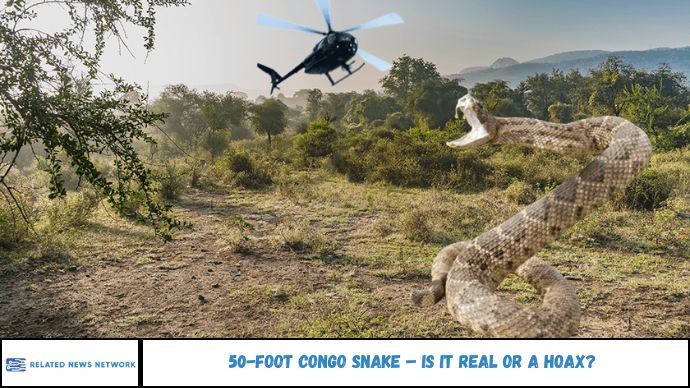
50-Foot Congo Snake – Is It Real or a Hoax? In the dense heart of the Congo rainforest, one of the world’s most mysterious snake legends slithers into the spotlight. A massive 50-foot serpent, reportedly spotted from a military helicopter in 1959, has sparked fascination, fear, and fierce debate.
Could such a snake truly exist in modern times? Or is it simply another jungle myth, exaggerated by memory and mystery?
- The origin of the 50-foot Congo snake story
- Scientific analysis of the photograph and sighting
- Known facts about large snakes
- Expert opinions and hoax theories
In 1959, Colonel Remy Van Lierde of the Belgian Royal Air Force was conducting a routine helicopter patrol over the Katanga region of the Congo. A seasoned pilot with over 400 combat missions under his belt, Van Lierde had honed the ability to spot danger from above—a skill that would make his next encounter unforgettable.
As he scanned the terrain, something extraordinary caught his eye. Slithering through the jungle below was a colossal snake, which he estimated to be over 50 feet (15 meters) in length. Both he and his copilot were stunned by the sheer size of the creature. If accurate, the sighting would make it the largest snake ever recorded, far surpassing today’s known giants.
For comparison, green anacondas typically grow to around 15 feet, and reticulated pythons can occasionally exceed 20 feet, according to the Natural History Museum in London. But a snake over 50 feet? That would rewrite the biological record books.
Still, many herpetologists and biologists remain skeptical. There is no verified scientific evidence of any snake reaching such a length in modern times. Experts suggest the sighting may have been a misjudged optical illusion or a case of wartime misinterpretation.
Yet despite the doubts, Van Lierde’s account endures—shared on cryptozoology forums, podcasts, and conspiracy circles. Whether fact, fiction, or something in between, the tale continues to fuel our fascination with the idea of giant snakes hidden in the world’s unexplored wilderness.
The Origin of the 50-Foot Congo Snake Myth
The 1959 Sighting
The most famous claim comes from Belgian Colonel Remy Van Lierde, who said he spotted a giant snake over 50 feet (15 meters) long and 2 feet wide while flying over the Congo. He snapped a photograph, which shows a large snake coiled in the underbrush.
According to Van Lierde:
- The snake lifted its head 3 feet above the ground
- He believed it could swallow a man whole
- The snake was so large the pilot wouldn’t risk landing
The photograph was later shared with the public, fueling decades of speculation.
What Does Science Say About Giant Snakes?
The Largest Verified Snakes
While impressive, modern science has never confirmed the existence of a snake 50 feet long.
The largest scientifically documented snakes include:
- Green Anaconda (Eunectes murinus) – Up to 29 ft (8.8 m)
- Reticulated Python (Python reticulatus) – Up to 33 ft (10 m), though rare
The longest verified snake ever was a reticulated python named Medusa, measuring 25 feet, 2 inches (7.67 m).
Could a 50-Foot Snake Exist?
Experts say it’s biologically unlikely for a modern snake to reach 50 feet due to:
- Metabolic limits
- Prey size availability
- Environmental factors
Dr. Roy McDiarmid, herpetologist at the Smithsonian, noted:
“There’s no credible evidence of a 50-foot snake. Extraordinary claims require extraordinary proof.”
Analyzing the Congo Snake Photo
The infamous image taken by Van Lierde has been scrutinized by experts and enthusiasts.
Key Considerations:
- No scale reference proves the snake’s actual size
- Some believe shadows and vegetation distort perception
- Critics suggest it may be a large python or a visual illusion
Without more images or the actual creature, the photo can’t be independently verified.
Did Giant Snakes Exist in the Past?
Yes—prehistoric snakes like Titanoboa did exist.
- Titanoboa cerrejonensis, which lived around 60 million years ago in what is now Colombia, reached lengths of 42–47 feet (12.8–14.3 m) and weighed over 2,500 lbs (1,135 kg).
- It thrived in humid, hot climates similar to the Congo.
This shows that environments can support enormous serpents—just not in the present day, according to available evidence.
Alternative Theories: Hoax, Misidentification, or Truth?
Some possible explanations for the 50-foot Congo snake include:
- Optical illusion from aerial perspective
- Exaggerated memory or false scale estimation
- Deliberate hoax to draw attention or create lore
- Undiscovered species—less likely, but not impossible in remote jungles
Many herpetologists agree: Until physical evidence surfaces, the claim remains unverified
FAQs
1. Has a 50-foot snake ever been found?
No. The largest confirmed snake in history, Titanoboa, reached 47 feet, but no modern snake has exceeded 33 feet.
2. Who saw the Congo snake?
Belgian Colonel Remy Van Lierde reported the sighting in 1959 from a helicopter over the Congo.
3. Is the Congo snake photo real?
The photo exists, but its scale and authenticity are debated. No physical evidence was ever recovered.
4. Could a snake grow to 50 feet today?
Biologists say it’s highly unlikely due to environmental and physiological constraints.
5. What’s the biggest snake alive today?
The green anaconda and reticulated python are the largest, averaging 20–30 feet.
6. Could it be a new species?
While remote areas can hide unknown species, no credible evidence supports this claim yet.
Conclusion
The legend of the 50-foot Congo snake lives on as one of the most debated cryptozoological mysteries of the 20th century. While the photo and eyewitness account are intriguing, no scientific verification supports the existence of such a creature today.
Could it have been a visual illusion, a misjudged anaconda, or even a remnant of a prehistoric species? Until concrete proof emerges, the story remains a captivating blend of curiosity, skepticism, and imagination.