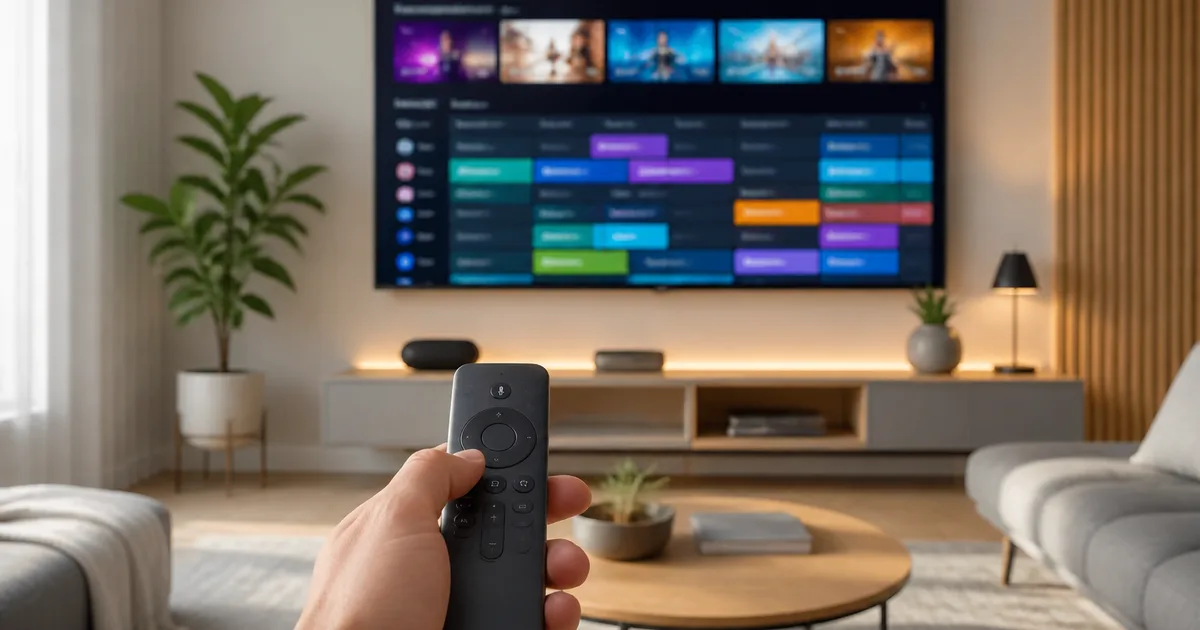
The British living room of 2026 looks superficially like the one of a decade ago: a large screen on the wall, a sofa facing it, a remote on the arm. Underneath that familiar surface, almost everything has changed. The television is a computer with an app store. The small stick plugged into its side is another one. The remote has a microphone. The signal arriving at the screen comes down a broadband line rather than from a dish or an aerial, and the people watching are as likely to be on three different screens as gathered around one.
This feature looks inside that room: the device ecosystem that now defines home viewing, the shift to app-first television, the rise of profiles and multi-room viewing, the role of voice, how viewers decide whether a service is worth keeping, and the security basics that too many households still skip.
A room full of connected devices
The modern living room is layered. At the centre sits a smart TV, which ships with its own operating system, app store and streaming capability. Beside or behind it, very often, is a streaming stick or box, bought either because the television’s built-in software felt sluggish or because the household wanted a consistent interface across several sets. Games consoles, soundbars with their own apps, and the phones and tablets in everyone’s pockets complete the picture.
What unites these devices is that they all run software, and software can be updated, replaced and extended. A television that was a fixed appliance has become a platform. For viewers, this means the choice of what to watch is no longer dictated by which cables run into the house but by which apps are installed. Internet-delivered television, or IPTV, is a natural fit for this environment because it arrives as an app like everything else, requiring no additional hardware beyond what the household already owns.
That shift is reflected in how people shop for television. Rather than asking which pay-TV package to sign up for, households increasingly search for comparisons and recommendations, with queries such as best iptv uk serving as a starting point for understanding which services operate in Britain, what they offer and how they perform on the devices already in the home.
App-first television
The defining feature of the 2026 living room is that television is organised around apps rather than channels. The home screen of a smart TV or streaming stick presents a grid of services, and the viewer moves between them in the way they move between apps on a phone. Live channels, catch-up players, on-demand libraries and IPTV services sit side by side, each a tile away.
This has quietly changed what viewers expect from any television service. They expect it to launch quickly, to remember where they left off, to work the same way on the bedroom television as in the lounge, and to be available on a phone when they are away from home. A service that cannot meet those expectations, however good its content, feels dated. Providers in the IPTV space have had to compete on app quality as much as on line-up, and the better ones treat their apps as the product rather than an afterthought.
Live television, reinvented
Live viewing has not disappeared in the app era; it has been absorbed into it. A live channel inside an IPTV app behaves much like a broadcast channel, with an electronic programme guide, but it gains the ability to pause, to restart a programme from the beginning, and to jump into catch-up for something missed earlier. For sport and news, where liveness still matters, this combination is a significant step up from a traditional set-top box.
Profiles, multi-room and the end of the single screen
Households no longer watch together by default. Different family members have different tastes, schedules and screens, and the services that serve them well recognise this through user profiles, which keep recommendations and watch histories separate, and through simultaneous connections, which let several people stream at once.
Multi-room viewing used to require multiple boxes and multiple subscriptions. Today a single IPTV subscription with an appropriate number of connections can serve the lounge television, a bedroom set, a tablet in the kitchen and a phone on the train. When households compare services, the connection count has become one of the first questions asked, because it determines whether one subscription can genuinely replace the collection of boxes a traditional pay-TV household may have accumulated over the years.
Voice, remotes and the interface
The remote control has changed too. Most streaming sticks and many smart TVs now ship with voice-enabled remotes, and asking the television to open an app, find a programme or jump to a channel has become normal in households that would once have scrolled through menus. Voice search does not replace the programme guide, but it reduces friction, especially for viewers who find on-screen keyboards tedious.
Interface quality matters more than it once did because viewers switch between services so often. A guide that loads slowly, a search that returns poor results or an app that forgets its place quickly becomes a reason to cancel. Viewers have become sensitive to these details in a way that was unnecessary when the only interface was a channel number.
How viewers judge a service in 2026
With so many options a tile apart, loyalty has become conditional. Viewers judge a service continuously and are quick to move on when it falls short. Conversations with households, and the questions people ask when researching the best IPTV UK options for their home, point to a consistent set of criteria.
- Stability under load. Does the stream hold up during a busy Saturday evening or a major live event, or does it buffer when it matters most?
- Picture quality in practice. Labels such as HD and 4K mean little without a well-provisioned stream behind them. Viewers increasingly test a service on their own connection during a trial before committing.
- App quality across devices. The service should work consistently on the smart TV, the streaming stick, the phone and the tablet, and should be available through official app stores.
- Content fit. A line-up that matches what the household actually watches beats a large headline channel count.
- Transparent terms. Clear pricing, flexible subscription lengths, straightforward cancellation and recognisable payment methods.
- Responsive support. Real support hours and a quick route to help when something goes wrong.
- Legality. A provider that is clear about operating lawfully and does not advertise content it could not plausibly have the rights to show.
The last point deserves emphasis. IPTV is a neutral delivery technology used by legitimate broadcasters and licensed services, but the category also attracts operators selling access to channels and sporting events they have no right to distribute. Viewers should choose providers that hold proper content licences and operate legally in the UK, and should treat offers that promise every premium channel and every fixture for a trivial price as a warning sign rather than a bargain. If it looks too good to be true, it almost certainly is. Households should also remember that watching live television in the UK, however it is delivered, falls within the scope of the TV licence rules.
Security basics for the connected living room
A room full of connected devices is also a room full of potential weak points, and the security habits of many households have not kept pace with their hardware. A few basic measures go a long way.
- Install apps from official stores. Unofficial installations bypass the checks that app stores perform and are a common route for malware onto streaming devices.
- Keep everything updated. Televisions, sticks and apps all receive security updates; enabling automatic updates removes the need to remember.
- Use strong, unique passwords. Account credentials for television services are a target, and reusing a password from elsewhere multiplies the damage of any breach.
- Secure the router. A strong Wi-Fi password, an updated router and a separate guest network for visitors protect every device in the home at once.
- Set up parental controls. Profiles with age restrictions and PIN-protected purchases prevent both unsuitable viewing and accidental spending.
- Be cautious with payment details. Pay through recognisable methods and be wary of any service that requests unusual payment routes or excessive personal information.
The living room as a platform
The 2026 living room is less a place where television is received than a place where it is chosen. Smart TVs, streaming sticks and the apps running on them have turned the screen into a platform, and viewers have become active, discerning customers rather than passive subscribers. Providers serving this market well tend to be the ones that invest in their apps, are transparent about their terms and are clear about operating lawfully. Maxco, a provider serving viewers in the UK and Spain with live channels, on-demand libraries and multi-device apps, is one example of the app-first services that households now encounter when researching their options. As with any provider, prospective subscribers should apply the same checks on licensing, device support and terms before committing.
For households trying to identify the best IPTV UK experience for their own home, the answer in 2026 depends less on any single feature than on how a service behaves across every screen in the house, every evening of the week, and whether it will still be there, lawfully and reliably, next year.