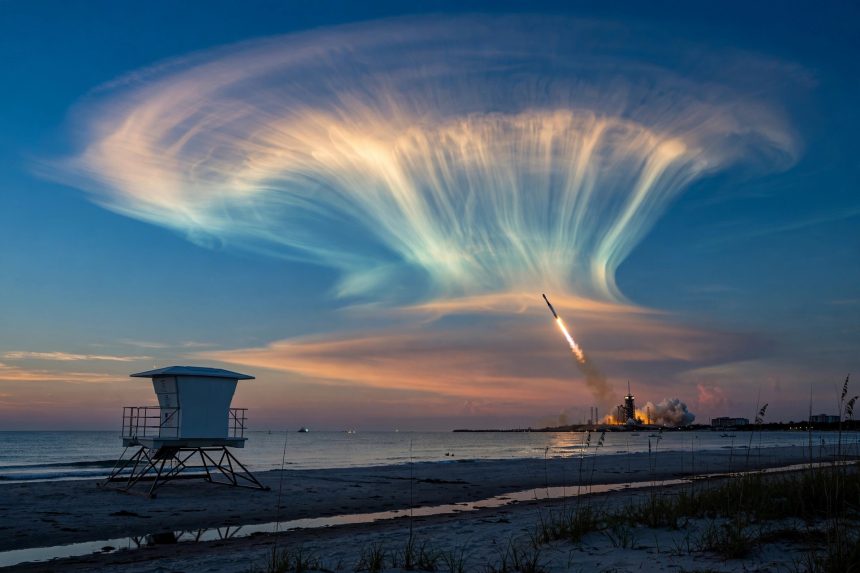
Early risers along the United States east coast were treated to an extraordinary sight before dawn on Tuesday, 13 October, when a SpaceX rocket launch created a vast, glowing “jellyfish cloud” that drifted high above the Atlantic. The luminous plume, photographed from Florida to New York, spread out like the bell and tentacles of a jellyfish as the rocket climbed towards orbit, drawing hundreds of amazed reports and photographs from sky watchers across several states.
The display followed the 6.33am ET launch of a Falcon 9 rocket from Cape Canaveral Space Force Station in Florida. The mission, known as CRS-35, sent a Dragon cargo spacecraft towards the International Space Station with around 6,300 pounds of supplies, experiments and equipment for the crew in orbit, including a final pair of roll-out solar arrays. It was SpaceX’s 35th commercial resupply flight for Nasa, and on paper it was a routine run to low Earth orbit. What made it unforgettable was the timing.
A Perfect Alignment of Darkness and Sunlight
The launch took place 48 minutes before sunrise in Florida, and that narrow window is the key to the whole phenomenon, as The Guardian reported in its coverage of the event. On the ground, observers were still standing in darkness. High above them, however, the rocket and its exhaust plume had already climbed into sunlight. The plume expanded in the thin upper atmosphere, its water vapour freezing into tiny ice crystals that caught and scattered the first light of the day.
The result was a cloud that appeared to glow from within, shifting through shades of white, blue and faint rainbow colour as it spread. Because the exhaust was released so high, the effect could be seen hundreds of miles from the launch site. As EarthSky explained, observers were able to spot the jellyfish from as far as 800 miles away, a distance that explains why photographs poured in from Georgia, the Carolinas, Virginia, Pennsylvania and the New York area.
Why the Plume Looks Like a Jellyfish
The shape is not an accident. Near the ground, a rocket’s exhaust is held in a tight, bright column by the surrounding air. As the vehicle climbs, the air pressure around it falls sharply, and the plume is free to expand outwards into a broad, rounded fan. Viewed from below at dawn or dusk, that fan forms the domed “bell” of the jellyfish, while narrower streamers of vapour and the rocket’s continuing trail hang beneath it like tentacles.
Meteorologists call this kind of display a twilight phenomenon. It can only happen when a launch occurs shortly before sunrise or shortly after sunset, when the geometry lines up: a dark sky at ground level, and direct sunlight still striking the upper atmosphere. Daytime launches produce spectacular vapour trails too, but they are lit evenly and lack the eerie contrast. Night launches, by contrast, can pass through the sunlit layer too quickly, or leave a plume that is only briefly illuminated.
Sightings From Florida to New York
Residents across the south-east captured the cloud in the minutes after lift-off, with particularly striking images from Florida’s Atlantic coast, where the plume hung over the ocean as the sky began to lighten. Further north, the view was more distant but no less strange: a slow-moving, luminous form high in a still-dark sky, easily mistaken at first glance for something far more mysterious than a cargo rocket.
Nasa shared photographs of the display on social media, and the replies filled quickly with images from amateur photographers and early commuters who had stopped to look up. For many, the surprise was part of the appeal.
Anyone watching future launches online should also take a moment to protect the accounts they use for streaming and social media, a point covered in our guide to account security essentials, since big live events often attract phishing attempts and fake stream links.
Another Chance to See One Soon
Those who missed Tuesday’s show may not have long to wait. Another Falcon 9 launch is scheduled from the same Cape Canaveral pad on Monday, 19 October, with an hour-long window opening at 6.30am ET, a little more than half an hour before the 7.01am sunrise. If the weather cooperates and the timing holds, the same twilight geometry could produce another jellyfish over the Atlantic.
Forecasters advise would-be observers to find a spot with a clear view towards the east and north-east, arrive well before lift-off, and allow their eyes time to adjust to the darkness. The most dramatic moments usually come a few minutes after launch, as the rocket reaches the sunlit layer and the plume begins to bloom.
As launch rates continue to climb, these accidental light shows are becoming a familiar, if still startling, feature of life along the Space Coast and far beyond it. For a few minutes on Tuesday morning, a routine delivery run to a space station turned the dawn sky into something closer to a deep-sea creature drifting overhead, and reminded millions of people to simply look up.