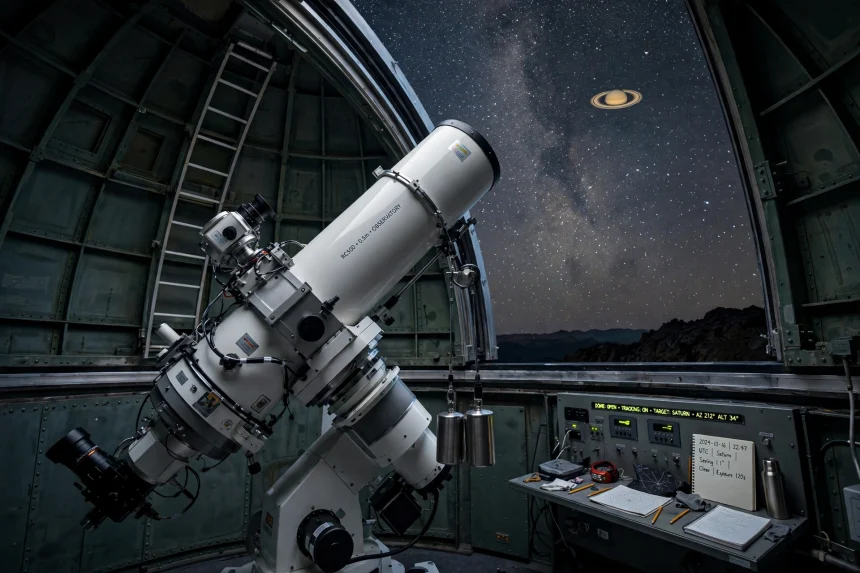
A major update to the solar system’s most basic facts has arrived. Saturn now has 274 confirmed moons after astronomers recognised 128 additional objects, a jump from the previous total of 146 that puts the ringed planet ahead of all other planets combined. The finding, covered here for relatednewsnetwork.com readers, rests on a long telescope survey and careful orbital verification, and it reveals a distant population of small, irregular moons whose origins say a great deal about how the outer solar system evolved over billions of years.
The Network of Moons Around One Planet
Related stories often connect in unexpected ways, and Saturn’s moons now form the largest connected family in the solar system. Confirmation of 128 new moons has raised the planet’s total from 146 to 274, exceeding the combined count for all other planets. The announcement follows a long survey with the Canada-France-Hawaii Telescope on Mauna Kea, with orbital work involving University of British Columbia researchers including Dr Edward Ashton. Recognition by the International Astronomical Union formalised the result. In related coverage, our report on a SpaceX launch creating a jellyfish cloud showed public fascination with the sky; this finding, though less visible to the eye, is far more consequential for astronomy.
From Faint Dots to Confirmed Orbits
A moon is confirmed only when its orbit is known well enough to find it again. That standard explains the long timeline. Astronomers collected deep exposures over several years and used shift and stack, aligning images on the expected motion of a Saturn moon so its light accumulated into a detectable point. Each candidate then needed repeat observations. The Canada-France-Hawaii Telescope provided the sensitivity, while careful tracking ruled out asteroids that happened to cross the field. The story is not that 128 objects appeared at once, but that evidence for 128 objects finally passed the threshold for official recognition.
Irregular Orbits Tell a Violent Story
The additions are small, typically a few kilometres across, and they keep their distance from Saturn. Their orbits are tilted, elongated and frequently retrograde, travelling against the planet’s rotation. Regular moons, formed in a disc around a young planet, tend to behave in a more orderly way. Irregular moons look like visitors. Researchers think Saturn captured them gravitationally, after which collisions shattered some into families of fragments. Dr Ashton’s team at the University of British Columbia has pointed to tightly grouped fragments as evidence of relatively recent breakups, at least on cosmic timescales, which helps date activity in the outer solar system.
Connections Across the Solar System
Placing Saturn’s system alongside its neighbours clarifies the scale. Jupiter, long Saturn’s main rival, has 95 confirmed moons. Saturn now leads it by 179, a gap that reframes questions about why one giant planet collected so much more material. Gravity, location and chance all played roles, and the fragment families give modellers new constraints. Related reporting, such as our guide to IV drip therapy and NAD+, follows the same principle readers expect here: separate what is measured from what is merely suggested. What is measured is a population of small bodies whose orbits now form the best census of a giant planet’s distant companions.
A Census That Is Still Incomplete
Astronomers are careful not to call 274 a final answer. Every improvement in sensitivity has revealed smaller and fainter objects, and this survey was designed to push that boundary using images gathered patiently over years. Future work will refine orbits, assign designations and perhaps group more fragments with their parent collisions. It may also find additional moons. For now, the verified census stands, and its implications ripple into planet-formation theory, telescope planning and public understanding. Saturn is no longer simply the ringed planet. It is the solar system’s outstanding example of how much company a giant world can gather, hold and break apart over billions of years.
One More Point of Context
Teachers and students can use this update as a clean example of how scientific counts actually work in practice. A total changes not when an object first appears in an image, but when repeated evidence meets an agreed standard and a recognised authority records it. That distinction explains why the number jumped so sharply in a single announcement: the work behind it accumulated quietly for years. It also cautions readers to ask, whenever a record changes overnight, what verification process has just finished rather than what object has just arrived.