Introduction
As a business grows, managing employees becomes more complex. Hiring new team members, maintaining employee records, processing payroll, tracking attendance, and coordinating onboarding all require time and consistent processes.
What works for a small team may become difficult to manage when the workforce expands. HR teams that once handled employee information through spreadsheets and emails may find themselves dealing with duplicate records, delayed approvals, repetitive data entry, and increasing administrative workloads.
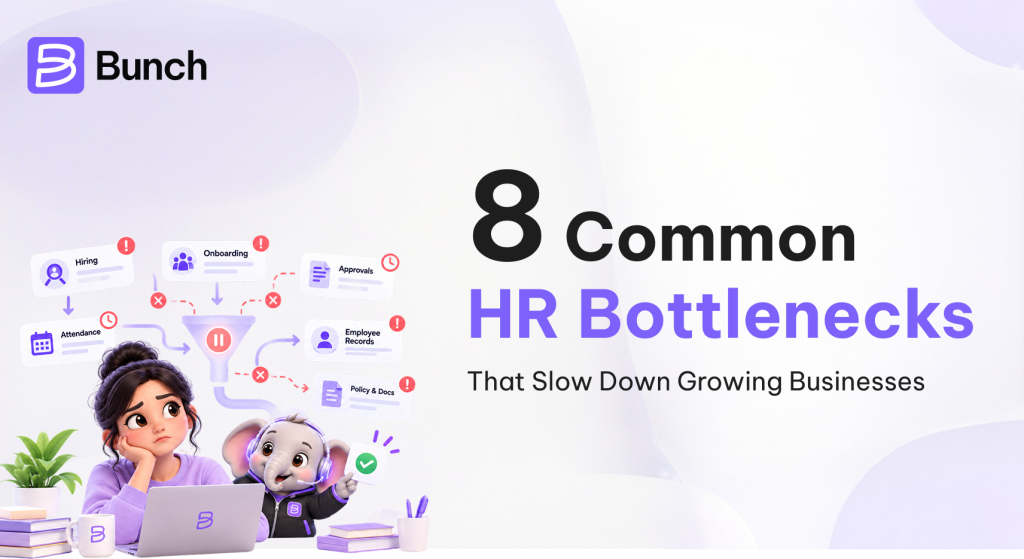
These challenges are known as HR bottlenecks. They slow down routine processes, create additional work for employees, and can affect the overall employee experience.
The solution is not always to hire more HR staff. In many cases, businesses can improve efficiency by identifying the source of delays, standardizing processes, and using suitable HR technology.
Here are eight common HR bottlenecks that slow growing businesses and practical ways to address them.
1. Slow Recruitment and Hiring Processes
Recruitment becomes difficult to manage when a business has several open positions and no consistent process for handling applications. HR teams may receive resumes through email, job portals, referrals, and social media, making it harder to track every candidate.
Delays can also occur when interview feedback arrives late, hiring managers have different expectations, or approvals take too long.
As a result, suitable candidates may lose interest or accept offers from other employers.
How to fix it:
- Define the hiring process and responsibilities for each stage.
- Maintain a central record of applicants and interview progress.
- Establish timelines for reviewing applications and providing feedback.
- Standardize interview scorecards and evaluation criteria.
- Coordinate with hiring managers before publishing job openings.
A structured recruitment process helps HR teams identify where applications are getting delayed and keeps hiring managers aligned.
For growing businesses, the goal is to make hiring more predictable without compromising candidate evaluation or the quality of recruitment decisions.
2. Employee Information Is Scattered Across Different Systems
When employee records are stored across spreadsheets, email attachments, shared folders, and separate HR applications, finding accurate information becomes time-consuming.
An employee’s contact details may be recorded in one spreadsheet, employment documents in another folder, and reporting information in a separate system. If any of these records change, HR may need to update several locations.
This creates the risk of outdated information, duplicate entries, and confusion about which record is correct.
How to fix it:
Maintain a centralized employee database that stores essential information, including employee details, job roles, departments, reporting relationships, and relevant documents.
Set clear rules for updating records and assign responsibility for maintaining data accuracy. Access should also be restricted according to employee roles to protect confidential information.
An HR management system can help bring employee records and related documents into one workspace. For example, HR management software from Bunch brings employee information, documents, payroll, attendance, recruitment, and asset records together.
Centralized records reduce the need to search across multiple tools and make routine HR administration easier to manage.
3. Manual Attendance and Leave Tracking
Attendance and leave management can become complicated when businesses rely on paper registers, spreadsheets, email requests, or separate applications.
HR teams may need to compare attendance records with approved leave requests before preparing monthly reports or processing payroll. Missing entries and inconsistent updates can create additional work.
Employees and managers may also struggle to understand leave balances or confirm whether a request has been approved.
How to fix it:
- Establish a consistent attendance-recording process.
- Define leave policies and approval responsibilities.
- Keep attendance and leave records updated.
- Review exceptions such as missing entries or discrepancies.
- Connect attendance data with payroll where the system supports it.
Using a centralized attendance management process can reduce repetitive reconciliation and make records easier to review.
Businesses should select a system that supports their actual work arrangements, including relevant shift patterns, leave policies, and attendance devices.
4. Payroll Processing Takes Too Much Time
Payroll is one of the most sensitive HR processes because employees expect their salaries to be calculated accurately and paid on time.
When salary information, attendance, leave, deductions, and employee details are maintained separately, HR teams may need to collect and verify information manually before every payroll cycle.
This can lead to repeated calculations, additional checks, and delays when records do not match.
How to fix it:
Keep employee information, attendance records, approved leave, and relevant salary details organized in a consistent process. Establish a payroll calendar and review changes before processing salaries.
A connected HR and payroll system can reduce duplicate data entry by using the same employee records across related processes.
Bunch provides payroll management connected with employee information, attendance, and leave data. This can help businesses reduce manual reconciliation between separate records.
However, payroll still requires appropriate review. Businesses should verify salary components, deductions, applicable statutory requirements, and exceptions before finalizing payments.
5. Employee Onboarding Is Inconsistent
A new employee’s first few days often involve collecting documents, setting up access, explaining policies, assigning equipment, and introducing the person to the team.
When these activities are managed through informal messages and separate checklists, important steps can be missed. A new hire may not receive the required documents on time or may have to wait for access to essential tools.
Inconsistent onboarding can also create extra work for HR, IT, managers, and other departments.
How to fix it:
Create a standardized onboarding checklist covering the employee’s first day, first week, and initial training period.
Include tasks such as:
- Collecting and verifying required documents.
- Preparing offer letters and employment records.
- Arranging system access and equipment.
- Sharing company policies and role expectations.
- Assigning onboarding responsibilities to relevant team members.
- Scheduling introductions and training sessions.
Track each activity until it is completed. A clear process makes responsibilities easier to follow and helps new employees settle into their roles.
For businesses hiring regularly, an organized onboarding workflow also reduces the need to rebuild the process for every new employee.
6. HR Teams Spend Too Much Time on Repetitive Administrative Work
HR professionals handle many recurring tasks, including answering routine employee questions, updating records, sending reminders, preparing reports, and collecting approvals.
When these activities are handled manually, they can take time away from recruitment planning, employee development, workforce planning, and other important responsibilities.
The problem becomes more noticeable as the number of employees increases.
How to fix it:
Start by identifying tasks that follow the same steps every time. Use templates, standardized forms, recurring reminders, and automated workflows where appropriate.
For example, businesses may use structured processes for document collection, onboarding tasks, leave approvals, and routine notifications.
HR software can also help keep employee records, documents, attendance, and payroll information connected, reducing the need to enter the same details repeatedly.
The aim is not to automate every HR activity. Sensitive decisions, employee concerns, and complex situations still require human judgment. Focus on repetitive administrative tasks that can be handled more consistently.
7. HR and Department Managers Struggle to Coordinate
HR rarely works in isolation. Recruitment depends on hiring managers, onboarding may involve IT and operations, and payroll depends on accurate information from multiple sources.
When departments communicate through disconnected channels, responsibilities can become unclear. A manager may delay approving a leave request, a new employee’s equipment may not be ready, or a change in employment details may not reach the relevant team in time.
These delays can affect several processes at once.
How to fix it:
Define who is responsible for each HR activity and establish clear approval workflows. Document important decisions and make relevant information accessible to authorized team members.
Shared task lists and dashboards can help employees see pending actions, assigned responsibilities, and deadlines.
For example, an onboarding workflow can assign separate tasks to HR, IT, and the hiring manager while keeping progress visible in one place.
Regular coordination between departments helps prevent small delays from becoming larger operational problems.
8. Limited Visibility Into HR Performance and Workforce Needs
Businesses need reliable information to understand workforce requirements, monitor administrative performance, and plan future hiring.
However, when employee records, attendance, payroll, and recruitment data are maintained separately, preparing reports can require significant manual effort.
Managers may find it difficult to answer questions such as how many positions remain open, which onboarding activities are delayed, or where HR teams are spending the most time.
How to fix it:
Identify the HR metrics that support your business decisions. Depending on your needs, these may include:
- Time taken to fill open positions.
- Completion of onboarding activities.
- Attendance and leave patterns.
- Payroll processing accuracy.
- Employee turnover.
- Pending HR requests and approvals.
Use consistent data definitions and review trends over time rather than relying on isolated figures.
An HR management system with reporting capabilities can make relevant workforce information easier to access. Better visibility helps managers identify recurring issues and decide where process improvements are needed.
How HR Management Software Helps Reduce Bottlenecks
Many HR bottlenecks have a common cause: information is spread across different systems, routine processes depend on manual updates, or responsibilities are unclear.
HR management software can help businesses organize employee records and connect related processes such as recruitment, onboarding, attendance, payroll, and document management.
For example, Bunch brings these HR functions into one workspace. Employee information can support related workflows, while attendance and leave data can feed into payroll processes. The platform also includes recruitment and employee asset management capabilities.
Before adopting a system, businesses should review its features, reporting options, access controls, implementation requirements, and pricing. The best choice is one that addresses the organization’s actual bottlenecks without creating unnecessary complexity.
Software alone will not fix an unclear process. Businesses should first identify where delays occur, establish ownership, and then use technology to support a more consistent workflow.
Conclusion
HR bottlenecks often develop gradually as a business grows. Recruitment slows down, employee records become harder to maintain, payroll requires more manual checks, and coordination between departments becomes increasingly complicated.
These challenges can affect both HR efficiency and the employee experience. However, businesses can address many of them by standardizing processes, maintaining accurate records, clarifying responsibilities, and reducing repetitive administrative work.
Start with the process that creates the most frequent delays. Improve it, measure the results, and then address the next bottleneck.
As your workforce expands, the right HR management system can help keep employee information and essential HR activities organized, allowing your team to spend less time managing administrative tasks and more time supporting employees.