
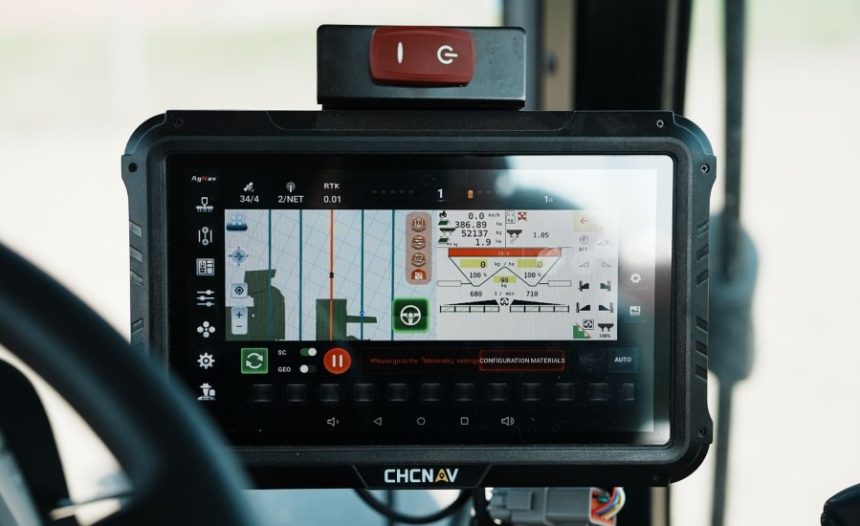
Precision agriculture has crossed a line. What was once a premium feature reserved for the largest arable operations is now a practical, fast-return upgrade for small and mid-size farms across Europe and beyond. At the centre of that shift is GPS autosteer — the technology that keeps a tractor driving a dead-straight line, pass after pass, without the overlaps, gaps and fatigue that come with steering by eye. If you are weighing up your first system, or replacing an ageing one, the number of options can feel overwhelming. This guide breaks down exactly what matters, so you can choose a system that fits your tractors, your fields and your budget.
What GPS autosteer actually does
At its simplest, an autosteer system takes over the physical job of steering a tractor along a planned path. It uses satellite positioning (GNSS) to know precisely where the machine is in the field, compares that to the line it is supposed to follow, and continuously corrects the steering to stay on track. The operator still manages headland turns, implement settings and in-field decisions — but the tedious, concentration-heavy task of holding a perfectly straight line is handled automatically.
The payoff shows up in three places. First, input savings: when every pass is guided, you stop double-spraying, double-fertilising and double-seeding the strips a human driver naturally overlaps for safety. Second, longer working days: a guided tractor can run accurately at dusk, at night or in dust and fog, when a driver’s eyes can’t. Third, reduced fatigue: operators finish the day far fresher, which matters enormously during tight planting and harvest windows.
Accuracy: the single most important decision
Not all autosteer is equally precise, and the accuracy you need depends entirely on what you grow. Accuracy is driven by the type of correction signal the system uses, and this is where buyers most often overspend or underspend.
Entry-level correction (free satellite-based systems such as SBAS) delivers pass-to-pass accuracy of roughly 15–30 cm. That’s perfectly adequate for broad operations like spreading fertiliser, spraying pasture or mowing, where a few centimetres of drift doesn’t hurt the result.
For anything that demands repeatable precision — row crops, strip-tillage, controlled-traffic farming, planting and precision seeding — you need RTK correction, which brings accuracy down to around 2–3 cm and, crucially, makes it repeatable season after season. RTK works by using a fixed reference point to correct the tractor’s position in real time. That reference can come from a subscription network or from your own on-farm base. Many farms that want full control and no recurring subscription invest in their own RTK base stations, which deliver consistent centimetre accuracy across the whole farm without depending on mobile coverage or a provider’s network uptime.
The key buying lesson here: match the correction type to the job. Paying for RTK to mow pasture is wasted money; relying on SBAS to plant precision rows will cost you in yield. Decide what your most demanding operation needs, and buy to that standard.
Assisted steering vs fully integrated systems
Broadly, autosteer comes in two forms. Assisted or retrofit steering adds a steering motor or a hydraulic kit to an existing tractor, turning the wheel (or feeding the hydraulics) to follow the guidance line. Fully integrated systems are built into the tractor at the factory and tie directly into its steering and electronics.
For most farms, retrofit systems are the sensible choice. They cost a fraction of a new autosteer-equipped tractor, they can be moved between machines, and modern kits achieve the same field accuracy as factory systems. This is why the retrofit market has grown so quickly — it lets a farm bring precision to tractors it already owns rather than committing to an expensive new purchase. When you browse GPS autosteer systems, you’ll find that the majority are designed precisely for this: upgrading working machines, not replacing them.
Will it fit your tractor? Compatibility comes first
The most common and costly mistake buyers make is ordering a system before confirming it fits their machine. Compatibility depends on several things: whether your tractor has a factory steering-ready provision, the type of steering it uses, the available hydraulics, and the electrical setup. Some tractors accept an electric steering motor on the column; others are better suited to a hydraulic kit that integrates with the steering valve.
Before you buy anything, confirm the match. A reputable supplier will provide a compatibility check so you know exactly which kit your model needs rather than guessing. It’s worth taking a few minutes to check whether a kit fits your tractor before ordering — it’s the difference between a bolt-on upgrade and an expensive return. Have your tractor’s make, model and year to hand, and note whether it already has any factory guidance provision.
Hydraulic vs electric-wheel steering
Among retrofit kits, the two dominant approaches are electric-wheel (a motor mounted on the steering column that physically turns the wheel) and hydraulic (which taps into the tractor’s hydraulic steering circuit to move the wheels directly).
Electric-wheel kits are generally quicker to install, easy to move between tractors, and well suited to machines used for lighter work. Hydraulic kits tend to offer smoother, faster, more precise response — particularly valuable on larger tractors, at higher speeds, and in demanding tillage or planting work. If you run heavier machinery or need the tightest possible line-holding, a hydraulic autosteer kit is often the stronger long-term choice, though it typically requires a more involved installation. The right answer depends on your tractors and your work: match the steering type to how hard the machine is actually worked.
Counting the real return on investment
Autosteer is one of the few precision-ag investments where the numbers are easy to justify. The savings come from several directions at once. Reduced overlap on inputs is the headline: even a conservative 5–10% reduction in overlap on seed, fertiliser and chemical adds up fast across a season, especially with input prices where they are. Fuel savings follow, because fewer wasted passes mean fewer engine hours. Then there’s the harder-to-quantify value: more accurate establishment, better crop uniformity, and the ability to work longer, more productive days.
For many farms, a retrofit autosteer system pays for itself within one or two seasons on input savings alone. After that, every season of reduced overlap and extended working hours is pure return. When you compare that to the cost of the kit, the economics are rarely in doubt — which is exactly why adoption has accelerated among farms that once considered precision ag out of reach.
Think beyond steering: building a precision foundation
A good autosteer system isn’t just about straight lines today — it’s the foundation for everything precision farming can do next. Once a tractor is steering accurately and repeatably, you open the door to controlled-traffic farming (confining wheelings to permanent tramlines to protect soil structure), section control (automatically shutting off seeding or spraying on overlaps and headlands), and variable-rate application (adjusting inputs across the field based on need).
None of those advanced techniques work reliably without accurate, repeatable guidance underneath them. So even if straight-line steering is all you need right now, buying a system with the accuracy and expandability to support these next steps protects your investment. It’s far cheaper to buy the right foundation once than to replace an under-specified system in two years.
Installation, training and support
A system is only as good as its setup. When comparing suppliers, look beyond the hardware price and ask what comes with it. Does the kit arrive with clear installation guidance, or professional fitting? Is there training so your operators actually use the system’s full capability rather than a fraction of it? What does ongoing support look like when you hit a question mid-season — because you will?
This is where buying from a specialist matters more than chasing the lowest headline price. Precision equipment bought from a generalist marketplace often arrives with no compatibility guidance, no setup help and no one to call. A supplier focused specifically on precision-ag equipment, like CMC SmartFarm, can confirm compatibility up front, supply the correct kit for your exact machine, and support you through installation and the first seasons of use. That support is frequently the difference between a system that transforms your operation and one that sits half-configured in the cab.
A practical buying checklist
To bring it all together, here’s the sequence to follow when choosing a system:
Decide your accuracy requirement first, based on your most demanding operation — SBAS for broad work, RTK for anything needing repeatable precision. Confirm tractor compatibility before anything else, with make, model and year to hand. Choose the steering type — electric-wheel or hydraulic — to match how hard your machine is worked. Check whether you need your own RTK base or can use a correction network, factoring in ongoing subscription costs versus a one-time base investment. Weigh the return against your real input costs, not a generic estimate. And finally, buy from a specialist who provides compatibility checks, the correct kit and genuine support — not just a box in the post.
The bottom line
GPS autosteer has moved decisively from luxury to sensible investment. The hardware has matured, retrofit kits have made it accessible to tractors already in the yard, and the return on reduced inputs and longer working days is fast and measurable. The farms getting the most from it are the ones that choose deliberately: matching accuracy to the job, confirming compatibility before buying, picking the right steering type, and buying from a supplier who supports them beyond the sale. Get those decisions right, and autosteer won’t just straighten your lines — it will lower your costs, extend your days, and lay the groundwork for everything precision farming has to offer next.