Isaac Newton – Laws of Motion and Universal Gravitation
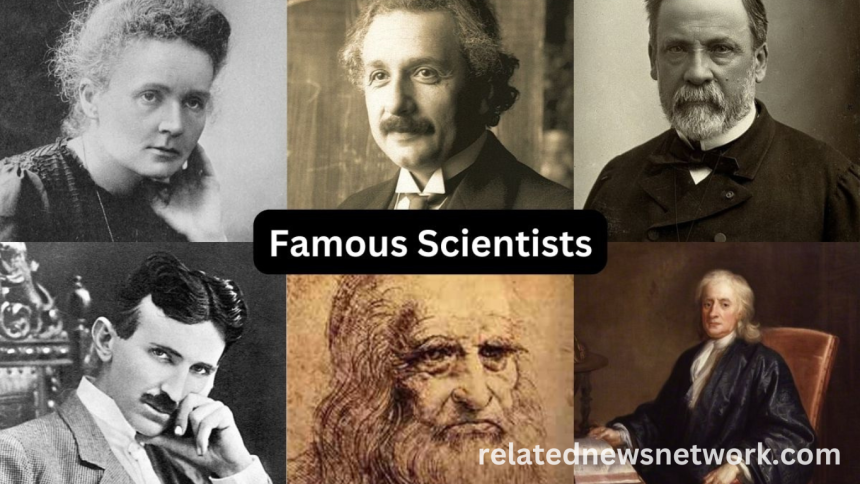
Isaac Newton, a pivotal figure in the scientific revolution, formulated the three laws of motion which laid the foundation for classical mechanics. His law of universal gravitation explained how objects are attracted to one another, offering clarity on planetary orbits and objects on Earth. Newton’s work in calculus, optics, and mathematics further solidified his place as a cornerstone of modern science.
Albert Einstein – Theory of Relativity
Albert Einstein redefined physics with his theory of relativity, especially the equation E=mc², which revealed the relationship between mass and energy. His work revolutionized our understanding of time, space, and gravity. Beyond relativity, Einstein’s contributions to quantum theory and the photoelectric effect paved the way for developments in modern physics.
Marie Curie – Radioactivity and Two Nobel Prizes
Marie Curie was a pioneering physicist and chemist who discovered the elements polonium and radium. She developed the theory of radioactivity, a term she coined. Curie was the first person to win Nobel Prizes in two different sciences—Physics and Chemistry. Her research led to advancements in cancer treatment and radiological medicine.
Galileo Galilei – Father of Modern Astronomy
Galileo Galilei played a vital role in the scientific revolution through his improvements to the telescope and his support of the heliocentric model proposed by Copernicus. He observed moons orbiting Jupiter, supporting the idea that not all celestial bodies revolve around Earth. His studies in motion laid groundwork for classical mechanics.
Charles Darwin – Theory of Evolution by Natural Selection
Charles Darwin transformed biology with his theory of evolution by natural selection, explaining how species adapt and change over generations. His work in “On the Origin of Species” offered a unifying explanation for the diversity of life on Earth. Darwin’s insights have influenced genetics, paleontology, and modern evolutionary studies.
Nikola Tesla – Innovations in Electrical Engineering
Nikola Tesla was an inventor and electrical engineer best known for his work on alternating current (AC), which revolutionized the power industry. Tesla contributed to wireless communication, radio waves, and electromagnetic fields. His visionary ideas laid the groundwork for technologies like wireless energy transmission and remote control.
Stephen Hawking – Black Holes and Cosmology
Stephen Hawking made profound contributions to cosmology, particularly in the study of black holes and the origin of the universe. His theory of Hawking radiation proposed that black holes emit radiation and can eventually evaporate. His work bridged the gap between quantum mechanics and general relativity, offering insights into the fabric of space-time.
Gregor Mendel – Father of Genetics
Gregor Mendel conducted experiments on pea plants, establishing the fundamental laws of inheritance. His work identified dominant and recessive traits and led to the formulation of Mendel’s Laws. Although overlooked during his lifetime, Mendel’s discoveries became the foundation of modern genetics and heredity.
Rosalind Franklin – DNA Structure Discovery
Rosalind Franklin played a critical role in understanding the molecular structure of DNA. Her X-ray diffraction images of DNA were pivotal in revealing the double helix structure. Though often overshadowed in history, her work provided the foundation for Watson and Crick’s model of DNA and influenced modern biology and genetics.
Richard Feynman – Quantum Electrodynamics and Science Communication
Richard Feynman was a theoretical physicist known for his contributions to quantum electrodynamics (QED), explaining how light and matter interact. He developed Feynman diagrams, a tool still used today to visualize particle interactions. Feynman also made complex science accessible through his lectures, becoming one of the most influential science communicators of the 20th century.
Frequently Asked Questions
Who is considered the father of modern physics?
Albert Einstein is widely regarded as the father of modern physics due to his theory of relativity and quantum contributions.
What did Marie Curie discover?
Marie Curie discovered the radioactive elements polonium and radium and developed the theory of radioactivity.
What is Isaac Newton most famous for?
Isaac Newton is known for formulating the laws of motion and the law of universal gravitation.
How did Charles Darwin impact biology?
Darwin introduced the theory of evolution by natural selection, revolutionizing the study of life and species development.
What was Nikola Tesla’s major invention?
Nikola Tesla pioneered alternating current (AC) technology, which became the standard for electrical power distribution.
Why is Gregor Mendel important in genetics?
Gregor Mendel’s experiments with pea plants established foundational principles of inheritance and genetic traits.
What did Rosalind Franklin contribute to science?
Rosalind Franklin’s X-ray images were crucial in uncovering the double-helix structure of DNA.
What was Stephen Hawking’s major scientific theory?
Stephen Hawking proposed that black holes emit radiation, known as Hawking radiation, and explored the nature of the universe.
Conclusion
The groundbreaking work of these ten scientists reshaped our understanding of the universe, life, and technology. Their discoveries continue to influence science, medicine, and innovation across the globe. From Newton’s laws to Franklin’s DNA research, each contribution built the foundation for modern advancements. Honoring their legacies inspires curiosity and a deeper appreciation for the relentless pursuit of knowledge that continues to drive humanity forward.