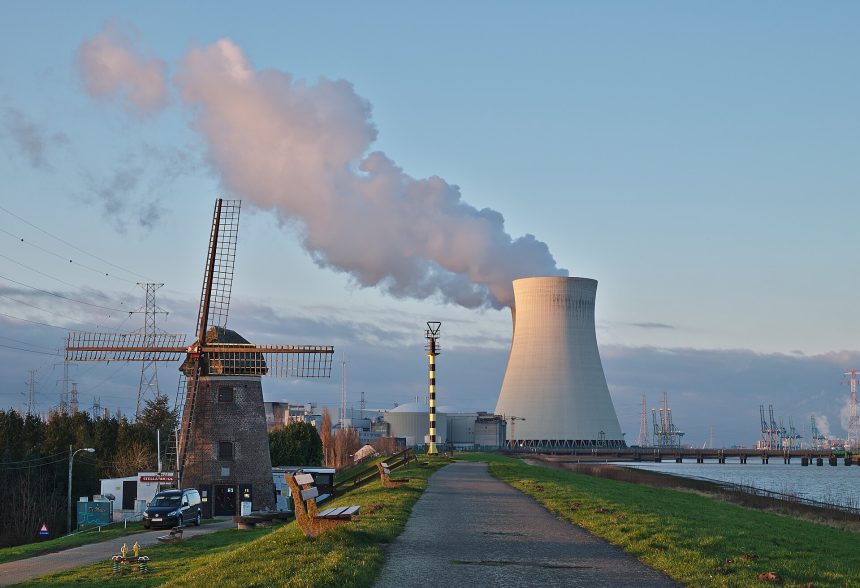
Molten salt reactors promise nuclear power that is safer by physics rather than by engineering — but they ask materials to survive hot, corrosive liquid salt for decades. Dutch developer Thorizon and research institute TNO have launched a programme to test exactly that, studying corrosion in support of the PIONEER reactor demonstrator.
Key points
The essentials from this report:
- Why molten salt, why now
- Corrosion is the whole ballgame
- PIONEER and the road to a demonstrator
- Europe’s nuclear renaissance context
Why molten salt, why now
In a molten salt reactor the fuel is dissolved in the coolant itself — a liquid salt that operates at high temperature and near-atmospheric pressure. The safety case is elegant: no high-pressure steam to burst, a fuel that expands and slows reactions as it heats, and designs that can drain passively to safety. The same salt that makes the physics kind makes the chemistry cruel — hence a research programme about what the salt does to the vessel, pipes and pumps over years.
Programme details are published by TNO, with advanced-reactor context from the IAEA.
Corrosion is the whole ballgame
Hot salts attack alloys selectively, leaching chromium and embrittling structures in ways that depend on salt purity, temperature gradients and even the salt’s chemistry drift over time. Predicting lifetime performance requires long exposure tests under realistic conditions — the unglamorous, multi-year work TNO specialises in. The programme will expose candidate materials to molten salt environments and measure the damage mechanisms precisely enough to write engineering rules from them.
How scientists know this
Findings of this kind are not single-experiment stories. They rest on converging lines of evidence — instrument records, replication by independent groups, and models tested against observations — assembled over years and argued over in the literature. Where uncertainty remains, it is usually about magnitude and timing rather than direction. That distinction matters for how the rest of us should hold the news: not as a coin flip between true and false, but as a picture sharpening at different speeds in different places.
PIONEER and the road to a demonstrator
Thorizon’s strategy is staged: cartridge-style reactor concepts that can be manufactured, replaced and scaled, with the PIONEER demonstrator intended to prove the integrated system. Materials data is the gating item for licensing — regulators will ask exactly the questions this programme answers, about corrosion allowances, inspection and component lifetimes. In nuclear development, the schedule is usually the paperwork; starting the corrosion clock early is how programmes buy back years later.
For more coverage of the stories shaping the day, visit our home page and the latest in the sciences.
Europe’s nuclear renaissance context
The work lands amid a broader European reconsideration of nuclear power: life extensions for existing fleets, large reactors back in energy strategies, and a generation of advanced designs — small modular, fast-spectrum, molten salt — competing for demonstration funding. Each design’s fate will be decided less by its brochure physics than by exactly this category of evidence: materials, manufacturability, and a licensing file that holds up.
Why this research matters beyond the lab
Basic research has a habit of becoming infrastructure. Measurements taken to answer a scientific question end up guiding engineering standards, insurance models, public investment and school textbooks. The lag can be decades, which is precisely why the funding and the observing systems behind work like this are worth defending in the present: the data not gathered this year is the question nobody can answer in twenty. Curiosity may start the work, but societies finish it — or fail to — with budgets.
Revolutions in energy are built from test coupons and corrosion curves as much as from vision. Thorizon and TNO have started the slow clock that every molten salt ambition must beat — and starting it is the news.