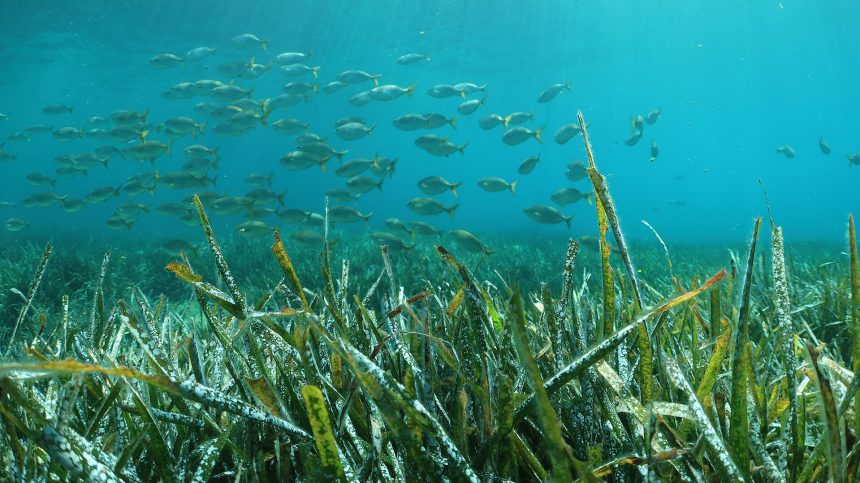
Seagrass is the only flowering plant that lives its whole life in the sea, and it may be the hardest-working habitat most people have never heard of. Meadows of seagrass occupy a sliver of the ocean floor yet bury carbon in their sediments at rates rivalling tropical forests, shelter juvenile fish and shellfish that underpin coastal fisheries, filter water, and blunt storm surges against the shore. They have also been disappearing — by many estimates a football pitch every thirty minutes, globally, for decades.
Now the story is turning. Restoration projects that once planted a few thousand shoots by hand are scaling to millions, funded by a new enthusiasm for ‘blue carbon’ — the climate value stored in coastal ecosystems — and by better science about how to make plantings survive. Readers of our environment coverage will know how rare a genuinely hopeful marine trend is; this one comes with careful caveats, which the evidence supports taking seriously.
Why Meadows Matter So Much
The carbon case starts underground. Seagrass sediments are low in oxygen, so buried organic matter decays extraordinarily slowly, locking carbon away for centuries to millennia. Lose the meadow — to dredging, pollution, anchors or heatwaves — and that store can be disturbed and released. Scientists working with NOAA and other agencies estimate coastal wetlands punch far above their area in climate terms, which is why they feature in national carbon inventories and why their protection counts as emissions policy, not just conservation.
The ecological case is broader still. Meadows are nurseries: a large share of the world’s commercial fish species spend part of their youth in seagrass. They host dugongs, turtles and seahorses, trap sediment that keeps water clear for coral reefs, and their root mats stabilise coastlines already threatened by rising seas.
Restoration Learns From Failure
Early restoration often failed because it treated seagrass like a garden plant: put shoots in, walk away. Survival rates were poor where the original cause of loss — murky water, excess nutrients, physical disturbance — remained. The successful new projects start by fixing conditions, then plant at scales that create self-reinforcing feedbacks: meadows clear their own water and calm their own currents, but only above a threshold density.
Technique has advanced accordingly. The landmark Virginia coastal project, which spread seed by boat across former meadows, now covers thousands of hectares and is studied worldwide as proof that large-scale recovery works when conditions allow. Elsewhere, biodegradable planting frames, seed-based sowing rather than transplanting adult shoots, and genetic selection for heat tolerance — increasingly vital as marine heatwaves intensify — are raising survival rates and lowering costs per hectare.
Blue Carbon’s Promise and Its Pitfalls
Carbon finance is restoration’s new engine and its sharpest controversy. Credits sold against future seagrass carbon can pay for planting at scales grants never reached, but carbon accounting in dynamic coastal systems is genuinely hard: growth varies, storms disturb sediments, and credits must not double-count carbon that protection policy already claims. The credible projects are responding with conservative estimates, long monitoring commitments and buffer pools — standards the wider blue-carbon market is now being pressed to adopt.
The Bottom Line
Seagrass restoration will not offset the world’s emissions, and its champions do not claim otherwise. Its value lies in stacking benefits no engineered solution matches: carbon stored, fisheries supported, coasts defended, in a single living system. Protecting what remains comes first — but the demonstration that lost meadows can return, at scale, is one of the decade’s real environmental advances, echoing the demonstration race in another field covered in our analysis of fusion energy’s milestone year.