Fusion energy has carried the same joke for fifty years — always thirty years away — but the industry now forming around it no longer behaves like a punchline. Private investment in fusion companies has passed nine billion dollars, more than thirty firms are building machines, and several are pouring concrete for plants intended to put electricity on a grid rather than papers in a journal. This year, by funding, construction and political attention alike, looks like the moment fusion became an industry.
The change is not that the physics suddenly became easy; plasmas remain as temperamental as ever. It is that three enablers matured together — powerful new superconducting magnets, computational control good enough to tame plasma instabilities in real time, and investors willing to fund engineering iteration rather than single flagship experiments. Our science coverage has tracked that convergence from curiosity to sector.
The Machines Racing to Net Power
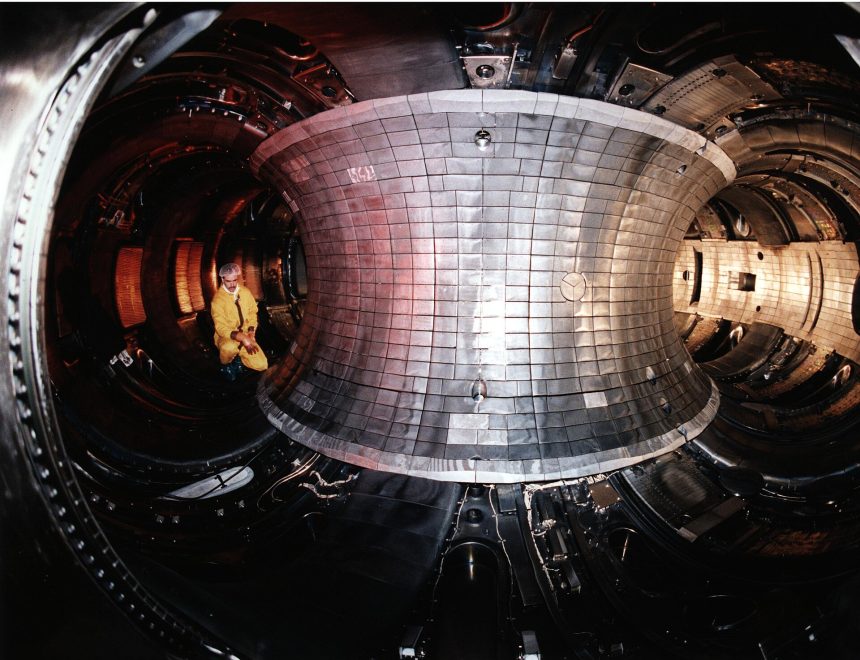
The field’s centrepiece remains ITER, the vast international tokamak in France, whose first plasma and deuterium-tritium phases have slipped into the next decade — a delay that, paradoxically, strengthened the private case. Companies such as Commonwealth Fusion Systems, spun out of MIT, bet that high-temperature superconducting magnets could shrink a tokamak to a fraction of ITER’s size and cost; its SPARC reactor, now under construction in Massachusetts, aims to demonstrate net energy gain before ITER does.
Rivals pursue different geometries. Helion’s pulsed approach, TAE’s beam-driven field-reversed configuration, and a new generation of stellarators — whose twisted magnets hold plasma stably without driving current through it — give the sector a portfolio quality: several shots on goal, on different physics, sharing one supply chain. The International Atomic Energy Agency’s outlook, published at iaea.org, now treats private timelines semi-seriously, a notable shift in tone from a traditionally cautious institution.
Why the Money Arrived
Investors cite a changed electricity market as much as changed physics. Data centres and electrification have revived demand growth in rich countries, grids need firm clean power that runs regardless of weather, and the customers — hyperscalers among them — have begun signing offtake agreements and investing directly, most visibly in Helion’s deal to supply Microsoft. Energy security politics help too: governments that fund fusion now frame it as industrial strategy, and regulators in the US and UK have deliberately chosen lighter-touch regimes, treating fusion more like particle accelerators than fission plants.
Scepticism remains rational. No private machine has yet produced net electricity, costs per kilowatt are unknown at plant scale, and materials that survive years of neutron bombardment are still being qualified. The honest industry line has shifted from promising dates to promising demonstrations.
The Supply Chain Behind the Science
An industry is visible in its suppliers, and fusion now has them. Specialist firms manufacture the high-temperature superconducting tape on which the compact-tokamak bet depends, winding it into magnets of unprecedented field strength; others produce the precision vacuum vessels, cryogenics, high-power lasers and neutron-resistant components that no catalogue previously stocked. Orders from fusion companies have become material revenue for several of these suppliers, and a workforce is forming — plasma physicists working alongside magnet engineers poached from MRI, aerospace and Formula One — that did not exist a decade ago.
The public programmes are repositioning within this new landscape rather than being replaced by it. ITER’s accumulated knowledge feeds private designs through publications and people; national laboratories increasingly act as testbeds and partners, offering facilities no start-up could build; and several governments have launched milestone-based funding schemes modelled on NASA’s commercial cargo programme, paying for demonstrated results rather than cost-plus effort. If fusion follows the pattern of that space precedent, the state’s role shifts from sole builder to anchor customer — and the milestone year’s funding figures suggest investors believe exactly that transition is under way.
The Bottom Line
Fusion’s milestone year is not the year it powered a city; it is the year capital, construction and customers aligned behind the attempt at full industrial scale. Whether the first plants arrive in the early 2030s or slip, the sector has crossed from publicly funded science into competitive engineering — the same transition from demonstration to deployment now under way in ocean restoration, as our report on seagrass and blue-carbon restoration shows from the natural world.