Understanding a sport as dynamic and nuanced as football requires more than just watching the players on the pitch. It demands familiarity with the XoilacTV common football terms and their meanings, which serve as the language of the game. Whether you’re a new fan or a seasoned supporter, knowing these terms enhances your appreciation and analytical skills—transforming your viewing experience from passive observation to active engagement. In this article, we’ll explore these essential football vocabulary, how to use them effectively, and compare their subtle nuances, helping you speak and understand the sport like a pro.
The Language of Football — Why Knowing the Common Football Terms and Their Meanings Matters
Football is culturally rich and diverse, but at its core, it relies on a shared vocabulary that facilitates communication among players, coaches, commentators, and fans. The common football terms and their meanings serve as a toolkit for describing actions, strategies, and game situations precisely and efficiently. For newcomers, grasping this terminology unlocks a deeper initial understanding, while for experienced fans, it sharpens commentary and discussion.
Having command over these terms allows you to interpret tactics, recognize formations, and anticipate plays with greater clarity. It bridges the gap between watching passively and analyzing actively. For example, understanding what a “through ball” entails or what a “pressing defense” signifies can give context to exciting moments or critical mistakes during a match. In essence, these terms form a shared language that unites fans around a common understanding, increasing engagement and enjoyment.
By integrating common football terms and their meanings into your conversations, you can elevate your football discourse, making your commentary sharper and your insights more compelling. Whether you’re debating strategies or celebrating goals, knowing when and how to use these terms correctly—like calling out a “counterattack” or a “set piece”—provides clarity and credibility. For true enthusiasts, this vocabulary is not just functional but a way to connect more deeply with the game’s culture.
Core Football Terms — Building a Foundation of Knowledge
Before diving into complex tactics or player roles, it’s crucial to master the fundamental terms that form the foundation of football language. These core words often recur during matches and are essential for anyone trying to understand the flow of the game.
Key Player Positions and Their Roles
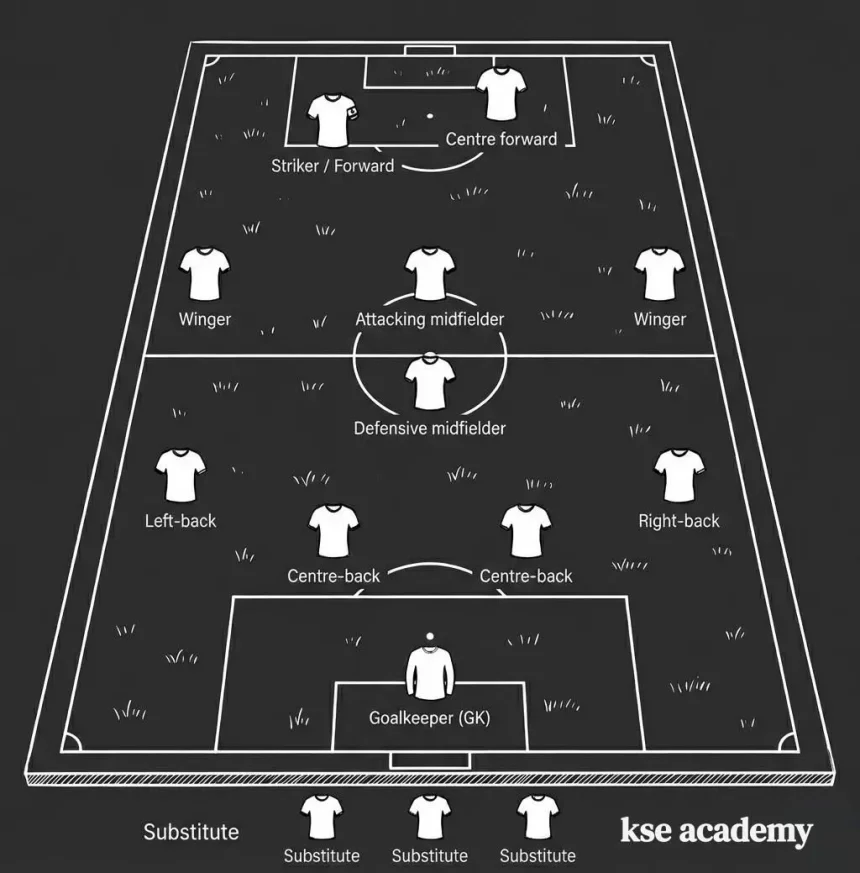
Knowing the positions on the field and their responsibilities is fundamental. Terms like “goalkeeper,” “defender,” “midfielder,” and “forward” are the basic building blocks of understanding team formations and strategy. Each position has specific tasks: the goalkeeper primarily prevents goals, defenders stop attackers, midfielders control the play in the middle, and forwards focus on scoring.
Understanding what each role entails helps you appreciate tactical setups like a “4-4-2 formation” or a “4-3-3 formation.” These terms describe how players are arranged on the field and are critical for analyzing team strategies. For example, describing a team as playing with a “flat back four” indicates a defensive line comprising four defenders aligned horizontally, which influences how they defend and attack.
Common Play Terms and Actions
Football terminology also includes describing specific actions like “dribbling,” “passing,” or “shooting.” Dribbling involves controlling the ball while moving, often with quick feet to evade opponents. Passing refers to moving the ball to a teammate efficiently, while shooting involves attempting to score by striking the ball toward the goal.
These actions form the basis of gameplay analysis. Recognizing a “through pass” or a “cross” adds layers of understanding to how attacking plays develop. For instance, when commentators mention a “pinpoint cross,” they emphasize the precision—highlighting the skill involved in creating scoring opportunities.
Defensive and Attacking Strategies
The language extends into describing team tactics, such as “pressing,” “counterattack,” or “set piece.” Pressing involves players harassing opponents to regain possession quickly. Counterattacks exploit moments when opponents are vulnerable after losing possession high up the pitch. Set pieces refer to dead-ball situations like free-kicks, corners, or throw-ins that teams use to create scoring chances.
Knowing these strategic terms enables fans to follow the flow of the game more closely and understand coaching philosophies. When a team is “employing high pressing,” it means they’re aggressive in trying to win back the ball early, often leading to exciting transitions.
Advanced Tactics and Their Nuances
Football is a constantly evolving sport, and understanding more sophisticated tactics equips you to analyze modern game strategies. Terms like “tiki-taka,” “false nine,” or “zonal marking” represent evolved concepts that go beyond basic actions.
Modern Formations and Tactical Setups
Contemporary teams often experiment with formations to gain strategic advantages. The “pentagon-shaped midfield” or “high-pressing 4-3-3” setup illustrates various tactical arrangements. These setups influence how teams defend, attack, and control the game tempo.
The “gegenpress,” an aggressive pressing style originating from Germany, involves instantly applying pressure after losing possession to regain the ball swiftly. Recognizing such terms informs your understanding of team identity and game plan. When commentators highlight a team’s “compact shape,” they refer to well-organized positioning that minimizes spaces for opponents.
Playing Styles and Systematic Approaches
Styles such as “tiki-taka” emphasize quick passing, possession, and patience, popularized by FC Barcelona. Conversely, “counterattacking football” prioritizes quick transitions and exploiting spaces left by opponents. Understanding these approaches helps you see the strategic philosophy behind team actions.
The “false nine” role features a forward who drops deep into midfield, confusing defenders. Recognizing this position adds depth to analysis, revealing how teams manipulate opponent formations to create scoring opportunities. Appreciating these nuances enriches your understanding of tactical sophistication.
Defensive Systems and Their Effectiveness
Defensive terms like “zonal marking” versus “man-to-man marking” describe different approaches to defending opponents. Zonal marking assigns defenders to specific areas, while man-to-man involves covering individual players. Each has strengths and weaknesses depending on the opponent’s style.
Understanding these nuances enables you to analyze why a team might switch tactics mid-game. For instance, when a team adopts a “parked bus” defensive style, they sacrifice some attack for defensive solidity, often frustrating opponents. Recognizing these strategies makes watching football a more intellectual and engaging experience.
How to Use the Common Football Terms and Their Meanings Effectively
Mastering football vocabulary alone isn’t enough—using it appropriately during discussions, viewing, or analysis enhances your communication skills. Here are practical tips to incorporate these terms confidently.
Practice Through Match Commentaries and Discussions
One of the best ways to cement your knowledge is by listening to expert commentaries and analyzing match reports. Try to identify the terms in action, noting how commentators describe specific plays or tactics. Repeating and integrating these words into your own discussions helps shift passive knowledge into active usage.
Engage with fellow fans on forums or social media, discussing game situations using proper terminology. This dialogue exposes you to varied contexts and deeper understanding, building your confidence. The more you practice, the more naturally these terms will become part of your football vocabulary.
Use Visual Aids and Tactical Diagrams
Diagrams, videos, and tactical maps are invaluable for understanding and 기억하는 football terminology. Visual learning helps connect words with actual movements on the pitch. For example, watching a clip of high pressing or a specific formation and then describing it with the correct term reinforces learning.
Create or study tactical charts that illustrate formations, set pieces, or play sequences. Labeling these diagrams with proper terminology enhances comprehension and recall. Over time, describing a game’s flow using accurate terms will feel instinctive rather than forced.
Applying Terms in Real-time Analysis
During live matches, challenge yourself to describe what’s happening using the correct vocabulary. For example, when a team employs a “counterattack” after winning the ball, verbalize it out loud if possible, or think through the play using the terms. This active engagement solidifies your understanding and makes commentary more insightful.
Additionally, when watching replays, pause to identify strategic elements—such as “zonal marking” in a defensive set-piece or “through ball” in an attacking move. Over time, this habitual mental practice transforms your appreciation from superficial to analytical, making you a more insightful football enthusiast.
Conclusion
Learning the Thuật ngữ bóng đá common football terms and their meanings isn’t just about expanding your vocabulary; it’s about accessing a richer, deeper understanding of the beautiful game. From fundamental player roles and action descriptors to complex tactical strategies, these terms provide the language necessary to analyze, discuss, and enjoy football at a higher level. By actively practicing, engaging with visual aids, and applying the vocabulary in real-time, fans can elevate their appreciation and become more connected to every pass, goal, and strategic move on the pitch. Mastery of football terminology unlocks a new dimension of the sport, making every game more thrilling, insightful, and memorable.