
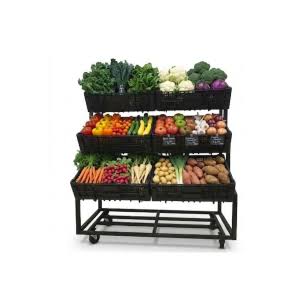
Displaying fresh vegetables effectively is important for grocery stores, supermarkets, roadside vendors, and produce markets. Poorly organized displays can make vegetables difficult to access, reduce product visibility, and create unnecessary handling problems. An outdoor vegetable display rack provides a practical way to organize fresh produce, improve customer accessibility, and make better use of available retail space.
Available in different sizes, materials, and configurations, these racks can accommodate a variety of vegetables. Selecting the right design helps retailers maintain attractive displays and efficient daily operations.
What Is an Outdoor Vegetable Display Rack?
An outdoor vegetable display rack is a shelving or display structure designed to hold fresh produce in open-air retail environments. These racks are commonly used at roadside markets, vegetable shops, grocery store entrances, and farmers’ markets.
Depending on the design, outdoor vegetable display racks may include tiered shelves, angled trays, removable containers, or multiple compartments for separating produce.
Their primary purpose is to provide organized product presentation while allowing customers to view and select vegetables conveniently.
Types of Outdoor Vegetable Display Racks
Different vegetable display rack designs support different retail layouts and produce handling requirements.
Multi-Tier Vegetable Display Racks
Multi-tier racks feature several shelves arranged vertically to maximize available display space.
They are suitable for retailers handling multiple vegetable varieties, including tomatoes, potatoes, onions, carrots, and leafy vegetables.
Slanted Vegetable Display Racks
Slanted racks position produce at an angle to improve visibility and accessibility.
This configuration allows customers to view products without reaching deeply into containers. Front stoppers and dividers can help prevent vegetables from falling or mixing.
Stainless Steel Vegetable Display Racks
Stainless steel racks provide a durable, cleanable structure for produce displays.
They are commonly used in grocery stores and supermarkets. For outdoor use, retailers should confirm that the rack’s construction and finish are suitable for exposure to moisture and changing weather conditions.
Portable Vegetable Display Stands
Portable racks can be moved between different retail locations or repositioned within a store.
These designs are useful for temporary markets, seasonal produce stalls, and businesses requiring flexible display arrangements.
Island Vegetable Display Racks
Island displays allow customers to approach products from multiple directions.
They can accommodate larger quantities of produce and are particularly useful in spacious retail environments with suitable customer circulation areas.
Key Benefits of an Outdoor Vegetable Display Rack
A well-designed vegetable display rack can improve store organization and customer shopping experiences.
Improve Product Visibility
An outdoor vegetable display rack makes different produce varieties easier to identify.
Tiered and angled shelves help customers view available products, reducing the need to search through large containers.
Maximize Available Space
Vertical shelving allows retailers to display multiple products within a smaller footprint.
This is particularly valuable for vegetable shops and market stalls with limited floor space.
Support Better Produce Organization
Separate compartments help retailers organize vegetables by type, size, or price.
Clear product separation also makes restocking and inventory checks easier for employees.
Simplify Cleaning and Maintenance
Racks with accessible shelves and removable trays can make routine cleaning more manageable.
Maintaining clean displays helps retailers keep produce presentation organized and hygienic.
Improve Customer Accessibility
Proper shelf heights and display angles make it easier for shoppers to select vegetables.
Retailers should maintain enough aisle space around racks to prevent congestion and support comfortable movement.
Best Materials for Outdoor Vegetable Display Racks
Material selection affects durability, maintenance, appearance, and suitability for outdoor environments.
| Material | Main Benefits | Considerations |
| Stainless Steel | Durable, cleanable, and corrosion-resistant | Choose a suitable grade for the environment |
| Powder-Coated Metal | Strong construction with different finish options | Coating damage may expose metal to corrosion |
| Wood and Metal | Combines structural support with a natural appearance | Wooden parts require protection from moisture |
| Plastic Crates With Metal Frames | Lightweight containers and easy produce separation | Check UV resistance and load capacity |
Businesses should consider local weather conditions, cleaning requirements, and expected product weight before selecting materials.
How to Arrange Vegetables on an Outdoor Display Rack
Effective product arrangement helps retailers maintain an organized and convenient shopping environment.
Group Similar Vegetables Together
Arrange vegetables according to type or category. Keeping root vegetables, leafy greens, and other produce in separate sections helps customers locate products.
Grouping also simplifies restocking and inventory monitoring.
Use Angled Shelves for Better Visibility
Angled display shelves allow vegetables to remain visible without requiring excessive stacking.
Retailers should avoid steep angles that cause produce to roll or place pressure on lower items.
Keep Heavy Vegetables on Lower Shelves
Potatoes, pumpkins, and other heavy produce should be placed on appropriately rated lower shelves.
Lighter and more delicate vegetables can be displayed higher where they remain accessible and protected from crushing.
Maintain Clear Price Labels
Visible price labels help customers identify products quickly.
Price-card holders or clips can keep pricing information organized without covering produce.
Avoid Excessive Stacking
Overloading display containers can damage delicate vegetables and make selection difficult.
Displays should contain manageable quantities, with additional inventory stored appropriately for replenishment.
How to Choose the Right Outdoor Vegetable Display Rack
Retailers should evaluate several factors before purchasing an outdoor vegetable display rack.
- Available space: Measure the display area and allow room for customer movement.
- Material durability: Select finishes suitable for the intended outdoor conditions.
- Shelf capacity: Confirm that shelves can support expected produce weights.
- Display configuration: Choose angled, tiered, or island layouts based on product variety.
- Cleaning access: Look for surfaces and containers that can be cleaned easily.
- Mobility: Consider portable designs when displays need frequent repositioning.
An appropriate rack should balance product visibility, storage capacity, and daily handling requirements.
How to Maintain Outdoor Vegetable Display Racks
Regular maintenance helps preserve rack condition and supports hygienic produce handling.
Shelves, trays, and containers should be cleaned according to their materials and usage conditions. Damaged components should be repaired or replaced before they affect product support.
Outdoor racks should be protected from prolonged exposure to rain and excessive sunlight where possible. Shade or weather protection may also help reduce produce deterioration.
Retailers should inspect structural joints, fasteners, and shelf supports periodically. Maintaining suitable weight limits prevents unnecessary damage and improves long-term usability.
Conclusion
An outdoor vegetable display rack helps retailers organize fresh produce, improve product visibility, and make efficient use of available space. Different configurations, including multi-tier, slanted, portable, and stainless steel racks, support a range of store layouts.
Choosing suitable materials, maintaining proper shelf capacity, and arranging vegetables carefully can improve day-to-day operations. Regular cleaning and maintenance also help keep produce displays organized and accessible.