ProxyLine is one of those proxy services that looks simple on the surface but becomes more interesting once you inspect the operational controls behind the order form. For this 2026 review, I focused less on marketing language and more on the things that affect day-to-day proxy work: how the service separates shared and private IPv4, whether SOCKS5 is offered alongside HTTP, how much control a buyer gets over subnets and cities, what the refund window actually says, and whether the pricing structure makes sense when the order grows.
My review method was practical rather than theatrical. I checked the public ordering flow, pricing grid, protocol options, location and subnet controls, support paths, replacement language and the way the service describes automation. I did not manufacture a synthetic speed chart or pretend that a short session proves month-long uptime. When I refer to network size, refund guarantees or performance claims, I identify them as published service specifications rather than independent laboratory measurements.
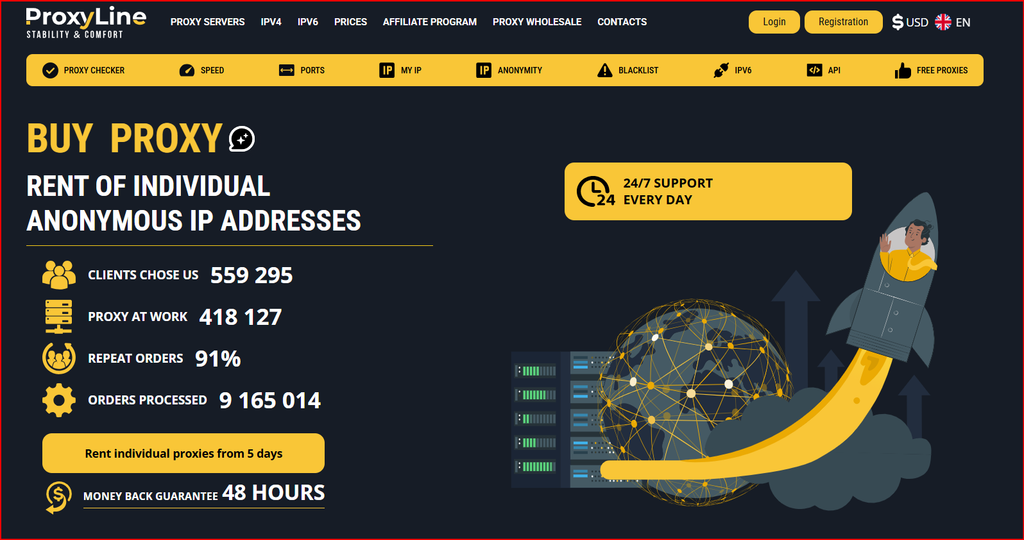
ProxyLine website screenshot used during this September 2026 review.
Review snapshot
| Category | My review note |
| Best for | SEO research, regional QA, automation, private proxy workflows |
| Core products | Shared IPv4, private IPv4, IPv6/32 and MTProto proxies |
| Standout controls | HTTP/SOCKS5, city/subnet selection, IP binding, API |
| Important caveat | Speed and long-term reliability claims were not independently load-tested in this review |
How I reviewed the service
I reviewed the current public product pages, pricing information, setup and configuration choices, support/refund language, and the operational controls a real customer sees before and after purchase. I separate published provider specifications from observations about workflow design. I do not present provider marketing claims as independent benchmark results, and I do not infer long-term uptime from a short review window.
What I checked before judging ProxyLine
The first thing I wanted to establish was whether ProxyLine is a basic reselling storefront or a platform with enough operational controls for repeat work. The public interface exposes proxy checking tools, port checks, anonymity checks, an API entry point and direct access to support. That matters because the quality of a proxy workflow is not only the IP itself; it is also how quickly you can choose, replace, bind and organize those IPs when a project changes.
I also looked at the published inventory model. ProxyLine separates shared IPv4 from individual IPv4 and offers IPv6/32 and MTProto options. That separation is useful because a low-cost shared address and a private address solve different problems. The site states that private IPv4 is issued to one user, while shared IPv4 can be used by up to three people. Buyers who need consistent reputation or account continuity should pay attention to that distinction instead of choosing solely by the cheapest monthly number.
Pricing: inexpensive entry points, but choose the product type carefully
The pricing grid is one of the strongest parts of the offer because it is transparent by rental period and quantity. Entry pricing is low enough to test a small pool without committing to a large monthly spend. Shared IPv4 is the cheapest general-purpose option, while individual IPv4 costs more in exchange for exclusivity. IPv6/32 is dramatically cheaper, but compatibility is not universal and should be validated against the target application before buying a large block.
For a buyer comparing only monthly price, the private IPv4 line is the most useful reference: the published rate for one to twenty addresses is $1.77 per IP for thirty days. Volume discounts appear as quantity rises. I would still start with the smallest useful pool and expand after verifying target-site compatibility, because a cheap IP that does not fit the workload is more expensive than a slightly higher-priced IP that behaves consistently.
You can confirm the latest numbers on the ProxyLine pricing page before ordering, because rates and availability can change.
Current pricing snapshot
| Plan / quantity | 5 days | 30 days | 90 days | 360 days |
| Shared IPv4, 1-20 IPs | $0.67/IP | $0.99/IP | $2.97/IP | $11.88/IP |
| Private IPv4, 1-20 IPs | $0.96/IP | $1.77/IP | $5.31/IP | $21.24/IP |
| IPv6/32, 1-99 IPs | $0.10/IP | $0.51/IP | $1.53/IP | $6.12/IP |
| MTProto, 1-20 IPs | $0.96/IP | $1.77/IP | $5.31/IP | $21.24/IP |
The feature I value most: control over IP selection
ProxyLine publishes manual IP selection, subnet selection and city selection as available controls. This is more important than it sounds. Two proxies from the same country can behave very differently if they come from the same narrow subnet or if the target service evaluates regional consistency. Being able to diversify subnets gives an operator a way to reduce concentration risk instead of accepting a random pool and hoping it is varied enough.
The service also lists IP binding for up to three IPs per order. In practice, authentication flexibility matters when a proxy is used across a workstation, a server and a backup node. It reduces the temptation to share credentials broadly or constantly edit whitelists. I would still document which machine is bound to which proxy, because operational discipline matters more as the pool grows.
HTTP and SOCKS5: useful flexibility without forcing two separate purchases
ProxyLine states that the system provides HTTP and SOCKS5 formats automatically. That is a practical advantage for teams using mixed software. Browser automation tools may accept either protocol, while some desktop clients, bots or developer utilities are easier to configure with SOCKS5. Having both formats available for the same purchased proxy lowers friction when the workflow changes.
I would not treat protocol choice as a performance guarantee. SOCKS5 can be convenient for a broader set of traffic, but the best option still depends on the application and how it handles authentication, DNS resolution and retries. The useful part here is choice: you can adapt the client to the proxy rather than replacing the proxy simply because one tool expects a different protocol.
Network diversity and scale
ProxyLine currently advertises more than 4,700 networks and subnets. I treat that figure as a provider-published inventory claim, not as an independent count. Even so, the availability of subnet selection makes the number more relevant than a headline pool size that customers cannot actually influence. For large SEO or localization projects, diversity is valuable because it lets you spread checks across distinct network blocks rather than hammering one subnet repeatedly.
The service also supports purchases from a single IP with rental periods starting at five days. That combination makes the platform suitable for both one-off validation and recurring projects. A five-day rental is particularly useful when you need to validate a target workflow before locking in a 90- or 360-day allocation.
Support, automation and the 48-hour replacement window
The public site says proxies are activated automatically after payment and that support/live chat is available 24/7. It also publishes a 48-hour refund or replacement guarantee. Those policies reduce the operational risk of testing a small pool, but I would still contact support quickly if an address fails a required use case rather than waiting until the end of the window.
The platform allows adding or removing IPs when renewing and includes auto-renewal. That is a small but useful quality-of-life feature for teams that do not want a pool to expire unexpectedly. My preferred workflow is to maintain an inventory sheet with purchase date, expiry, target use and replacement history; the provider dashboard should be a control surface, not the only record of what the team owns.
Where ProxyLine fits well – and where I would be cautious
I see the strongest fit in SEO data collection, regional website checks, controlled automation, software testing and other legitimate workflows where stable addressing and subnet diversity matter. The pricing makes it easy to separate projects into distinct pools rather than reusing the same addresses everywhere.
I would be more cautious when a project depends on a specific consumer ISP reputation or on mobile-network behavior, because this is not positioned as a residential or mobile proxy product. I would also avoid assuming that a published high-speed claim translates into identical real-world throughput in every country. Route quality, destination limits and local congestion still influence results.
Pros and limitations after my review
What I liked most is the combination of low entry pricing, private IPv4 availability, HTTP/SOCKS5 support, manual location/subnet control, API access and a short-term rental option. Those pieces make the service flexible for operators who want to start small and then standardize a repeatable proxy workflow.
The main limitation is that the most important performance claims remain provider claims unless you run your own workload-specific tests. IPv6 is attractive on price but should not be purchased in bulk until compatibility is confirmed. Shared IPv4 is inexpensive, but buyers should understand that sharing introduces reputation variables they do not control.
Final verdict
ProxyLine is a practical choice for users who value configuration control more than flashy dashboards. The service gives enough granularity to build a disciplined proxy pool: shared or private IPv4, IPv6/32, MTProto, HTTP/SOCKS5, city/subnet selection, IP binding and an API. The published pricing is competitive, and the five-day entry period lowers the cost of validating a workflow before scaling.
My recommendation is to treat ProxyLine as infrastructure rather than a magic bypass tool: start with a small private pool, document the assigned subnets, test the exact destination and only then increase quantity. Used that way, the platform offers a strong mix of price, control and operational flexibility in 2026.
Pros and cons at a glance
| Pros | Limitations |
| • Very low entry pricing | • Performance claims need workload-specific testing |
| • Private IPv4 + IPv6/32 + MTProto | • IPv6 compatibility varies |
| • HTTP/SOCKS5 | • Shared IPv4 reputation is not fully under your control |
| • Manual city/subnet selection | |
| • API and IP binding |
Who I think should consider it
ProxyLine fits SEO specialists, developers, QA teams and automation operators who need inexpensive private addresses and want direct control over city/subnet selection. It is especially attractive when a project needs several small, separated pools rather than one giant rotating endpoint.
Frequently asked questions
Does ProxyLine support SOCKS5?
Yes. The service publishes HTTP and SOCKS5 formats for its proxy products.
Are the IPv4 proxies private?
Individual IPv4 is described as issued to one user. Shared IPv4 is a separate lower-cost product that can be used by up to three people.
What is the shortest rental term?
The site says purchases can start from one IP with rental periods from five days.
Can I select a city or subnet?
ProxyLine lists manual IP selection, subnet selection and city selection among its available controls.
Is there a refund or replacement period?
The public site states a 48-hour refund/replacement guarantee. Check the current service rules before purchase because terms can change.
Bottom line
For buyers who understand the difference between proxy types and validate their target before scaling, ProxyLine offers a strong mix of price, control and practical workflow features in 2026.
Pricing and specifications checked in September 2026. Providers can change plans, limits, locations and terms; verify the current checkout page before purchase.