
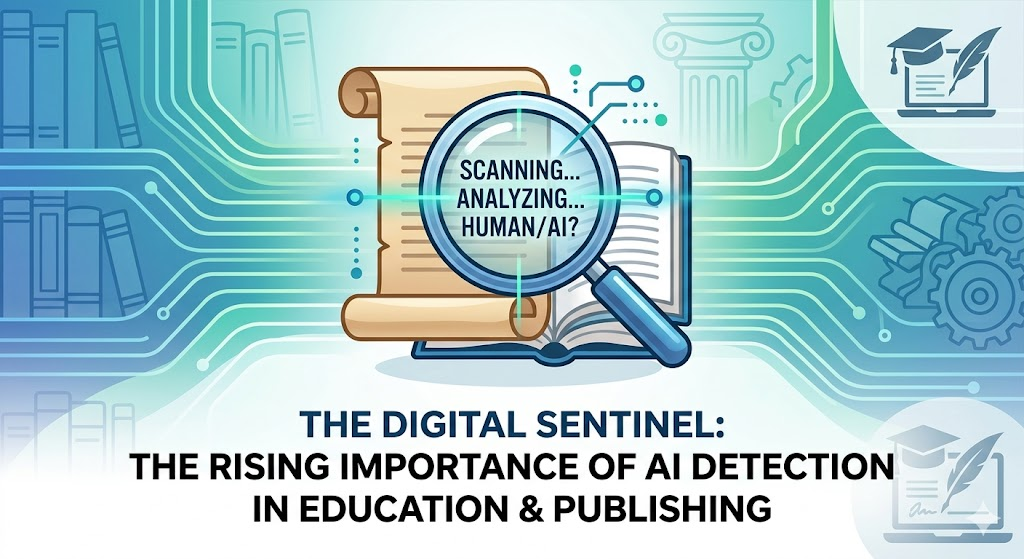
The rapid proliferation of generative artificial intelligence has fundamentally altered the landscape of content creation. In less than two years, Large Language Models (LLMs) have evolved from niche curiosities into ubiquitous tools capable of producing human-like prose, academic essays, and marketing copy in seconds. However, this “content explosion” has brought with it a complex set of ethical and practical challenges. As the line between human-generated and machine-generated text blurs, the demand for transparency has never been higher. This is where AI detection tools have stepped in, becoming essential infrastructure for the modern digital age.
From the hallowed halls of academia to the high-stakes world of digital publishing, the ability to verify the origin of text is no longer a luxury—it is a necessity. Tools like aidetector.ac are at the forefront of this movement, providing the clarity needed to maintain integrity in an era of automated writing.
The Evolution of AI and the Authenticity Crisis
For decades, the internet operated on a basic assumption of human authorship. While “spinning” tools and plagiarism have always existed, they were relatively easy to spot due to linguistic clumping and grammatical errors. Generative AI changed the math. Modern LLMs are trained on vast datasets, allowing them to mimic stylistic nuances, maintain logical flow, and adapt to specific tones.
This capability has led to an “authenticity crisis.” If a machine can write a compelling opinion piece or a complex research summary, how do we value human effort? In education, this threatens the traditional metrics of learning; in publishing, it threatens the trust between the reader and the outlet. AI detection tools function as the “digital fingerprints” analysts, using perplexity and burstiness metrics to identify the mathematical patterns inherent in machine-generated text.
Upholding Academic Integrity in the Age of LLMs
Nowhere is the impact of AI more visible than in education. For educators, the primary goal is to ensure that students are developing critical thinking and writing skills. When a student submits an essay generated by AI, they are bypassing the cognitive struggle necessary for learning.
The Shift in Pedagogy
Educators are currently caught in a balancing act. On one hand, they must prepare students for a world where AI is a standard professional tool. On the other, they must ensure academic honesty. Schools and universities have integrated AI detectors into their grading workflows to serve as a deterrent and a diagnostic tool.
AI detection is not merely about “catching” students; it is about fostering a culture of honesty. When students know that a platform like aidetector.ac can analyze their work for AI-generated patterns, they are more likely to engage with the material authentically. Furthermore, these tools allow teachers to have data-backed conversations with students, turning a potential disciplinary issue into a teachable moment about the ethical use of technology.
Protecting the Value of Degrees
If academic institutions fail to address the surge of AI-generated coursework, the value of their credentials diminishes. A degree signifies that an individual possesses specific knowledge and skills. If that knowledge was never truly internalized, the degree becomes a hollow credential. By implementing robust AI detection protocols, institutions protect their reputation and the long-term value of the education they provide.
The Publishing Industry: Quality, SEO, and Trust
In the world of professional publishing—be it journalism, blogging, or corporate communications—the stakes are equally high. The business of content is built on authority and trust.
Navigating Search Engine Algorithms
Search engines, most notably Google, have updated their guidelines to prioritize “helpful content” created for people, rather than content created primarily for search engine rankings. While Google does not strictly penalize AI content just for being AI, it does penalize “low-effort” content that adds no unique value. Because AI often hallucinates facts or relies on repetitive structures, pure AI content frequently falls into the “low-quality” category.
Publishers use AI detectors to audit their contributors and internal teams. Ensuring that a piece of content is primarily human-driven helps maintain search engine visibility and prevents the site from being flagged as a “content farm.”
Ethical Journalism and Brand Voice
For news organizations, the use of undisclosed AI is a major ethical breach. Readers expect a human perspective, unique insights, and factual accountability. If a publication is found to be passing off AI content as human journalism without disclosure, the brand damage can be permanent. Publishers utilize AI detection technology to verify the originality of freelance submissions, ensuring that every article meets the publication’s standards for depth and nuance.
How Businesses Leverage AI Detection
Beyond education and media, the broader business world is finding critical uses for AI detection. As companies move toward digital-first strategies, the integrity of their communication becomes a pillar of their brand identity.
- Hiring and Recruitment: Recruiters are increasingly seeing cover letters and “test assignments” that are 100% AI-generated. While using AI to polish a resume is acceptable to some, using it to complete a writing assessment makes it impossible to judge a candidate’s actual ability. HR departments use detectors to ensure they are hiring the talent they think they are.
- Legal and Compliance: In legal professions, the accuracy of a document is paramount. AI-generated legal briefs have famously included “hallucinated” case law. Law firms use detection tools to double-check internal drafts and external submissions to ensure that no unverified machine logic has crept into sensitive documents.
- Marketing and Social Media: Brands that pride themselves on “authenticity” use detection tools to ensure their social media managers and copywriters are maintaining a human touch. In an era of “dead internet theory”—the idea that most of the internet is bots talking to bots—human-centric brands stand out.
The Technical Side: How Detection Works
AI detectors do not work like traditional plagiarism checkers. A plagiarism checker looks for direct matches in a database of existing text. An AI detector, however, looks at the nature of the writing itself.
It analyzes two primary factors:
- Perplexity: This measures the complexity of the text. AI tends to choose the most “statistically probable” next word, resulting in low perplexity. Humans are more unpredictable.
- Burstiness: This refers to sentence structure and length. AI usually produces sentences of similar length and rhythm. Human writing “bursts”—it has a mix of short, punchy sentences and long, descriptive ones.
By analyzing these signals, tools can provide a probability score, indicating how likely it is that the text originated from an LLM.
The Future: A Collaborative Ecosystem
It is important to note that AI detection is not about the “prohibition” of AI. Rather, it is about attribution and intent. As we move forward, we will likely see a more collaborative ecosystem where AI is used for brainstorming and outlining, while humans handle the final creative output.
In this future, AI detection tools will serve as the “verification layer” of the internet. Just as we use SSL certificates to verify website security, we will use AI detection to verify content provenance. This ensures that when we read a heartfelt essay, a scientific discovery, or a critical news report, we can trust the source behind the words.
Conclusion
The rise of artificial intelligence is an unstoppable force, but it does not have to mean the end of human originality. By utilizing tools like aidetector.ac, educators can protect the integrity of the classroom, publishers can maintain the trust of their audience, and businesses can ensure the authenticity of their brand.
As AI continues to evolve, our methods for detecting it must evolve as well. AI detection is no longer just a technical tool; it is a fundamental guardian of human expression in the digital age. By valuing transparency and utilizing the right technology, we can harness the power of AI without losing the human element that makes communication meaningful.