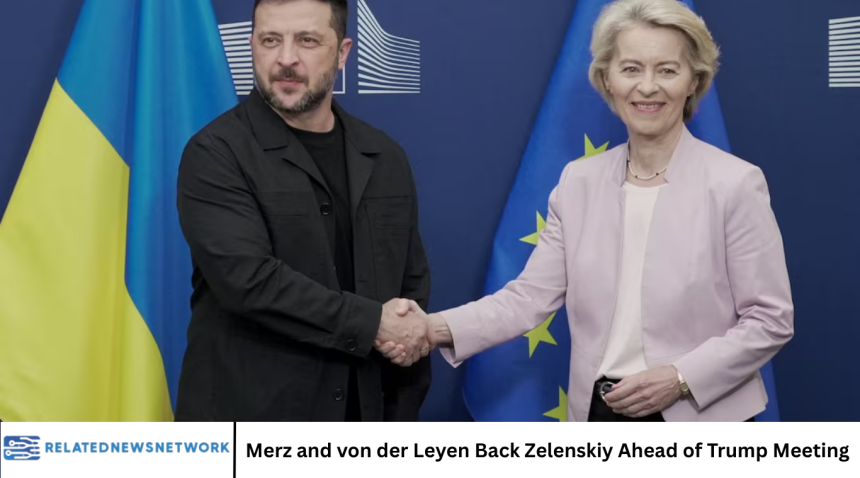
As Ukrainian President Volodymyr Zelenskiy prepared for a crucial meeting with U.S. President Donald Trump in Washington, he entered the stage flanked not just by his own delegation, but by leading European figures. German Chancellor Friedrich Merz and European Commission President Ursula von der Leyen, among others, publicly rallied behind Zelenskiy—signaling unwavering European solidarity at a fragile diplomatic moment.
This display of unity came amid concerns about Trump’s shifting stance on Ukraine, debates over security guarantees, and the broader transatlantic alliance’s future strategy toward the war in Eastern Europe.
In this article, we analyze the significance of Merz’s and von der Leyen’s support, the broader European strategy backing Ukraine, the diplomatic dynamics at play, and what it all means for global geopolitics.
The Stakes of the Meeting: Why Europe’s Presence Mattered
Ukraine’s meeting with President Trump was not an isolated bilateral session—it was surrounded by symbolic actors and high-stakes negotiation dynamics.
European leaders joined Zelenskiy at his request to:
- Counterbalance perceptions of Trump’s pivot toward rapprochement with Russia.
- Reinforce Ukraine’s centrality in shaping any peace framework.
- Present a unified Western front and insist on security guarantees that go beyond mere words.
This was more than diplomatic optics—it was about credibility, strategy, and cohesion among Western allies.
Merz’s Support: From German Politics to Global Message
Chancellor Merz, as a prominent conservative leader and possible successor to his predecessor, has used this moment to clarify Germany’s position firmly on Ukraine’s side.
He characterized Ukraine’s plight in stark terms: capitalism and democracy against aggression. He insisted that peace must not be confused with weakness, and that Europe—and the United States—must stand firm in safeguarding democratic principles.
Merz’s participation underscored that, regardless of domestic political debates, backing Ukraine remains a strategic non-negotiable for Germany.
von der Leyen’s Role: EU’s Bridge and Voice of Unity
Ursula von der Leyen, as EU Commission President, commands a unique transnational legitimacy. She joined the meeting “at the request of President Zelenskiy,” symbolizing the EU’s role as a bridge between national governments and as a collective actor with strategic influence.
She reaffirmed the EU’s commitment to long-term peace and declared: “We will support Ukraine as long as it takes.” Her presence also sent a signal that the EU stands ready to fulfill its share of any coalition of the willing—not as a peripheral actor, but as a full-fledged strategic partner.
The Coalition of the Willing: Europe’s Collective Strategy
More than two dozen European nations are part of an informal “coalition of the willing”—an alliance formed to coordinate pressure on Russia and support Ukraine through security guarantees.
Before the White House meeting, this group convened to hammer out unified messaging, align on military aid frameworks, and ensure collective bargaining power in discussions with Trump.
Those at the lectern with Zelenskiy—Merk, von der Leyen, Macron, Starmer, Meloni, and others—represented this broader coalition. Their presence served as a reminder that any pivot in U.S. policy could only move in tandem with an equally resolute European front.
Trump’s Posture: Negotiator or Wildcard?
President Trump entered the meeting with a reputation for impulsive diplomacy. His past Oval Office clash with Zelenskiy had given the impression he was pressuring Ukraine toward an immediate deal, possibly on terms favorable to Russia.
This time, Zelenskiy recalibrated—thanking Trump repeatedly, emphasizing gratitude, and nodding toward potential cooperation. European leaders hoped this show of diplomatic finesse might make Trump more receptive to shared objectives rather than transactional tactics.
Nevertheless, Trump’s true stance—whether forging a durable peace or using Ukraine as political leverage—remained the critical unknown.
What This Means for Transatlantic Cohesion
Europe’s bolstered support before the Washington meeting served multiple purposes:
- Reassurance: Ukraine and its allies showed solidarity when U.S. commitment appeared uncertain.
- Balance of Power: Europe reminded Trump that he was not dealing with Kyiv alone.
- Strategic Alignment: It reinforced messaging about lasting peace, deterrence, and democratic values, not short-term deals.
The coordinated approach also built conditions for possible post-conflict security guarantees involving multinational forces, potentially filling the vacuum if U.S. unilateral commitment faded.
Challenges Ahead
While unity was evident, hurdles remain:
- Diverging Priorities: European leaders and Trump may have differing views on timing, troop presence, and economic consequences.
- Moral vs. Realpolitik: Distance remains between Europe’s principled stance and America’s transactional politics.
- Fragmentation Risks: Any U.S.–Russia side dialogue could create divisions unless Europe stays unified.
The upcoming weeks will test whether the solidarity shown is procedural or based on enduring strategic alignment.
Frequently Asked Question
Why did European leaders join Zelenskiy’s meeting with Trump?
To present a united front, bolster Ukraine’s negotiating position, and encourage U.S. alignment with European strategic goals.
What did Friedrich Merz say supporting Ukraine?
He stressed that Europe must not confuse peace with appeasement, and that Ukraine deserves unwavering support.
How did von der Leyen articulate EU support?
She promised enduring EU assistance: “We will support Ukraine as long as it takes,” and endorsed U.S. contributions to security guarantees modeled on NATO Article 5.
What is the “coalition of the willing”?
A group of EU and allied nations banded together to coordinate political, security, and diplomatic strategy supporting Ukraine.
How did Zelenskiy approach Trump differently this time?
Through deliberate gratitude—thanking Trump repeatedly—to ease tensions and reset the tone from previous confrontations.
Is there risk of U.S.–Russia backchannel deals sidelining Europe?
Yes—without European engagement and visibility, America may pivot toward a deal that excludes Ukraine’s interests. Europe’s support is a guardrail against missing interests.
What’s next after the meeting?
Watch for agreed-upon security guarantees, joint statements, and follow-up summits. Any sign of fracturing will matter profoundly for future conflict resolution.
Conclusion
Merz and von der Leyen’s visible support for Zelenskiy ahead of his meeting with President Trump reinforced a fundamental truth: the future of European security and Ukraine’s survival depends on coordinated transatlantic and intra-European resolve.This moment of diplomatic alignment was more than political theater—it was a reminder that the global order still relies on alliances rooted in shared values and mutual conviction.