How Deep Is the Mariana Trench and What Have We Found in Its Depths?
The Mariana Trench, located in the western Pacific Ocean, is Earth’s deepest known oceanic point. Its extreme depth and inaccessibility have long made it a subject of fascination and mystery. But what exactly lies beneath its dark waters?
The ocean’s depths are beyond imagination—so vast that if Mount Everest were flipped upside down and placed inside the Mariana Trench, it would still be submerged with room to spare.
Hidden far beneath the waves, the Mariana Trench is home to an extraordinary array of deep-sea creatures that have adapted to survive in crushing pressure and complete darkness. Even more astonishing, a few brave explorers in high-tech submersibles have ventured to its floor, enduring extreme conditions to uncover the secrets of this mysterious, uncharted world.
Understanding the Depth of the Mariana Trench
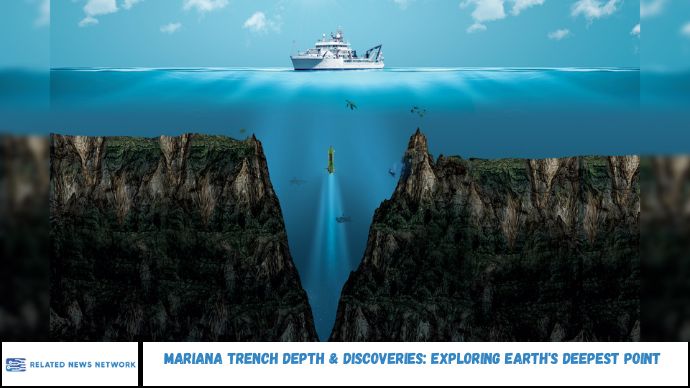
The Mariana Trench stretches over 1,580 miles (2,550 kilometers) and reaches a maximum known depth at Challenger Deep, approximately 36,037 feet (10,984 meters) below sea level . To put this in perspective, Mount Everest could easily fit into this trench with over 2 kilometers to spare.
In addition to Challenger Deep, other notable deep areas include Sirena Deep at 10,714 meters and Emden Deep in the Philippine Trench, which reaches depths exceeding 6,000 meters .
Human Exploration and Discoveries
Despite its extreme depth, the Mariana Trench has been the site of several human explorations. In 1960, Jacques Piccard and Don Walsh became the first to reach the bottom in the bathyscaphe Trieste. More recently, in 2019, explorer Victor Vescovo set a record by reaching 35,853 feet (10,927 meters) in Challenger Deep, discovering new marine species and, unfortunately, plastic waste, highlighting the pervasive issue of ocean pollution .
In 2024, oceanographer Dawn Wright became the first Black person to visit Challenger Deep, contributing valuable data to the Seabed 2030 initiative, which aims to map the entire ocean floor .
Life in the Deep: Unique Ecosystems
The trench’s extreme conditions—high pressure, low temperatures, and complete darkness—have led to the evolution of unique and resilient marine life. Species such as the snailfish, certain types of shrimp, and bioluminescent organisms have adapted to thrive in these harsh environments. These discoveries not only expand our understanding of marine biology but also underscore the resilience of life in Earth’s most extreme habitats.
Environmental Concerns: Pollution in the Deep
The Mariana Trench, once thought to be pristine, has not escaped the reach of human activity. In 2019, during his record-setting dive, Victor Vescovo reported encountering plastic waste, including a plastic bag and candy wrappers, at the ocean’s deepest point . This finding highlights the alarming extent of ocean pollution, with an estimated 8 million tons of plastic entering the oceans annually, affecting even the most remote marine ecosystems.
Scientific Significance and Future Exploration
Exploring the Mariana Trench is crucial for advancing scientific knowledge in various fields. Understanding its unique ecosystems can provide insights into evolutionary biology, while studying its geological features aids in comprehending tectonic processes. Furthermore, mapping the trench contributes to global efforts in ocean conservation and resource management.
As technology advances, future explorations may uncover more about this enigmatic part of our planet, potentially leading to discoveries that could benefit science and humanity.
FAQs
1. What is the Mariana Trench?
The Mariana Trench is the deepest part of the world’s oceans, located in the western Pacific Ocean.Wikipedia+1New Scientist+1
2. How deep is the Mariana Trench?
The deepest point, Challenger Deep, reaches approximately 36,037 feet (10,984 meters) below sea level.New Scientist
3. What have we discovered in the Mariana Trench?
Explorers have found new marine species and evidence of pollution, such as plastic waste.
4. Who has explored the Mariana Trench?
Notable explorers include Jacques Piccard, Don Walsh, Victor Vescovo, and Dawn Wright.
5. Why is the Mariana Trench important?
It offers insights into marine biology, geology, and the impact of human activity on deep-sea ecosystems.
6. Is the Mariana Trench still being explored?
Yes, ongoing research and expeditions continue to explore its depths and uncover new information.
May you also like it:
Is the Euphrates River Drying Up?
About Puwipghooz8.9 Edge: All You Need To Know
Conclusion
The Mariana Trench remains one of Earth’s final frontiers. Its extreme depth and unique ecosystems continue to captivate scientists and explorers alike. While human activity has reached even these remote depths, ongoing exploration and conservation efforts are essential to protect and understand this vital part of our planet.