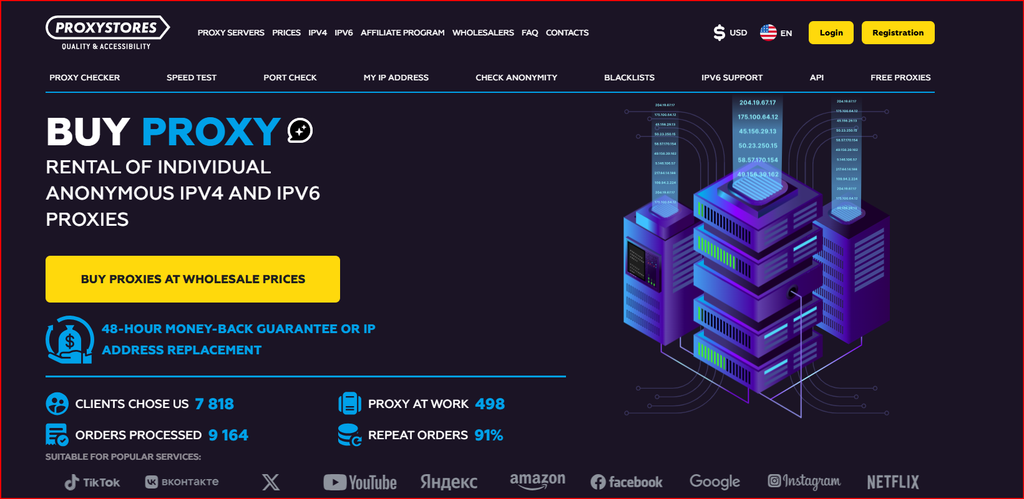
ProxyStores has a broad catalog, but the best way to review it is to separate the products by risk profile instead of treating every proxy as interchangeable. I reviewed the service with four questions in mind: when does shared IPv4 make sense, when is individual IPv4 worth paying for, where does IPv6 fit, and whether the MTProto option adds real value for Telegram-specific workflows.
I checked the public buying flow, plan descriptions, protocols, selection controls, support channels and published guarantee language. I did not assume that a homepage speed claim proves identical performance in every country. ProxyStores says individual proxies can reach up to 100 Mb/s and offers unlimited traffic; those are provider specifications that should be verified with the exact destination and region used in production.
ProxyStores website screenshot used during this September 2026 review.
Review snapshot
| Category | My review note |
| Best for | Private IPv4, social/SEO workflows, software integrations, Telegram MTProto |
| Core products | Shared IPv4, individual IPv4, IPv6/32 and MTProto |
| Standout controls | HTTP/SOCKS5, manual IP/subnet/city selection, IP binding |
| Important caveat | Shared IPv4 can be used by multiple users; target suitability still needs validation |
How I reviewed the service
I reviewed the current public product pages, pricing information, setup and configuration choices, support/refund language, and the operational controls a real customer sees before and after purchase. I separate published provider specifications from observations about workflow design. I do not present provider marketing claims as independent benchmark results, and I do not infer long-term uptime from a short review window.
The product catalog is clearer than it first appears
ProxyStores separates shared IPv4, individual IPv4, IPv6/32 and MTProto. That is a sensible catalog because these products solve different problems. Shared IPv4 lowers cost but introduces another user’s behavior into the reputation equation. Individual IPv4 gives one customer control of the address. IPv6/32 is much cheaper but has narrower compatibility. MTProto is purpose-built for Telegram traffic rather than general web proxying.
The service also supports HTTP and SOCKS5 formats and provides both automatically. For teams that use browsers, desktop tools and scripts together, that reduces configuration friction. A single proxy inventory can be consumed by different client types without buying separate protocol-specific products.
Pricing and value
The pricing grid is aggressive. Shared IPv4 starts at $0.99 per IP for thirty days in the 1-20 quantity band, while individual IPv4 is $1.77 per IP for the same period. IPv6/32 costs $0.51 per IP for thirty days at the smallest published quantity tier. These numbers make it inexpensive to build a test pool before committing to a larger order.
The value calculation changes with the workload. For non-critical tasks, shared IPv4 can be enough. For persistent sessions, client work or any workflow where a surprise blacklist would create rework, the difference between $0.99 and $1.77 per month is small compared with the cost of troubleshooting another user’s reputation problem.
You can confirm the latest numbers on the ProxyStores pricing page before ordering, because rates and availability can change.
Current pricing snapshot
| Plan / quantity | 5 days | 30 days | 90 days | 360 days |
| Shared IPv4, 1-20 IPs | $0.67/IP | $0.99/IP | $2.97/IP | $11.88/IP |
| Private IPv4, 1-20 IPs | $0.96/IP | $1.77/IP | $5.31/IP | $21.24/IP |
| IPv6/32, 1-99 IPs | $0.10/IP | $0.51/IP | $1.53/IP | $6.12/IP |
| MTProto, 1-20 IPs | $0.96/IP | $1.77/IP | $5.31/IP | $21.24/IP |
Manual IP, subnet and city selection
ProxyStores lists manual IP selection, subnet selection and city selection as available controls. This is one of the strongest parts of the service for QA and regional research. Country-only targeting can miss local differences, while city selection lets a tester reproduce a more specific customer context.
Subnet control matters for scale. A buyer can intentionally spread addresses across network blocks instead of accepting an overly concentrated pool. That does not make a proxy invisible, but it is a more professional way to manage network diversity.
IP binding and authentication flexibility
The service publishes IP binding for up to three IPs per order. This can simplify access from a workstation, a remote server and a backup environment without sharing credentials everywhere. It also reduces the need to update authentication settings every time work moves between machines.
I would still keep access tightly controlled. The convenience of three bound IPs should not turn into a loose allowlist. Document who owns each endpoint, revoke old entries and avoid binding addresses that are not under your control.
MTProto: a specialized product that makes sense
The MTProto offering is useful because it is not pretending to be a generic replacement for HTTP/SOCKS5. It is aimed at Telegram, where MTProto is a native proxy protocol. For teams that specifically need Telegram connectivity, having MTProto in the same account as general proxies reduces vendor sprawl.
For everything else, I would stay with private IPv4 over HTTP/SOCKS5 unless there is a clear reason to use IPv6. Specialization is a strength only when it matches the application.
Support, automation and replacement policy
ProxyStores says activation is automatic immediately after payment and that support is available 24/7. It also publishes a 48-hour refund or replacement guarantee. That makes initial validation less risky, but buyers should still test quickly and preserve evidence if a proxy is not usable for the intended purpose.
The ability to add or remove addresses during renewal and use auto-renewal helps with continuity. I prefer to treat renewals as an opportunity to clean the pool: retire problematic addresses, preserve good ones when possible and separate projects so one workload cannot contaminate another.
What I would improve
The biggest weakness is not a missing feature but the possibility of buyers choosing the wrong product because the prices are so low. Shared proxies are attractive, yet they are not equivalent to private addresses. IPv6 is cheap, yet not every target handles it well. The site could do more to guide buyers by workload and risk rather than simply displaying a large catalog.
I would also like to see more independently verifiable performance reporting by region. The published ‘up to 100 Mb/s’ figure is useful as a ceiling but not a substitute for latency, success-rate and route-quality measurements against real destinations.
Final verdict
ProxyStores is strongest as a flexible proxy toolkit rather than a single-product service. Private IPv4 is the most broadly useful option, shared IPv4 offers low-cost testing, IPv6/32 provides very cheap capacity where supported, and MTProto gives Telegram users a specialized path. The pricing is easy to understand and the control surface is mature enough for repeat operations.
For a serious workflow, I would start with individual IPv4, use subnet/city selection deliberately and treat the 48-hour window as a validation period. If the target behaves well, scaling is inexpensive. If the target needs residential or mobile identity, this is a different product category and ProxyStores should not be forced into a role it was not designed to fill.
Pros and cons at a glance
| Pros | Limitations |
| • Strong private/shared product split | • Shared proxies carry shared reputation risk |
| • HTTP/SOCKS5 | • “Up to 100 Mb/s” is not a destination benchmark |
| • MTProto option | • Buyers must match protocol/product to the workload |
| • Manual IP/subnet/city selection | |
| • 24/7 support and automation |
Who I think should consider it
ProxyStores is a good match for buyers who want one account covering several proxy types, including a Telegram-specific MTProto option. It works best when the operator understands the difference between shared reputation, private IPv4 and the narrower compatibility of IPv6.
Frequently asked questions
What is the difference between shared and private IPv4?
Shared IPv4 can be used by multiple users, while individual IPv4 is described as issued to one person.
Does ProxyStores support SOCKS5?
Yes. The service states that HTTP and SOCKS5 formats are produced automatically.
Can I select a city?
Yes. ProxyStores lists manual IP, subnet and city selection.
Does it offer MTProto proxies?
Yes. MTProto is sold as a separate product for Telegram-oriented use.
How long is the replacement window?
The public site states 48 hours for refund or replacement. Review the current service rules before buying.
Bottom line
For buyers who understand the difference between proxy types and validate their target before scaling, ProxyStores offers a strong mix of price, control and practical workflow features in 2026.
Pricing and specifications checked in September 2026. Providers can change plans, limits, locations and terms; verify the current checkout page before purchase.