SpaceProxy positions itself as a low-cost proxy service, but the more useful question is whether it provides enough controls for serious recurring work. In this 2026 review I examined the service from an operator’s point of view: plan separation, IPv4 versus IPv6 economics, protocol support, API access, subnet diversity, stream limits, refund rules and the practical workflow around buying, replacing and renewing addresses.
I deliberately avoided turning this into a fake benchmark article. I checked the platform’s published configuration and support flow and evaluated whether the product design is sensible for real proxy operations. SpaceProxy publishes figures such as 1,900+ networks/subnets and up to 2,000 streams; I treat those as provider specifications. Anyone running production scraping or automation should still benchmark the exact destination, geography and concurrency level before committing a large pool.
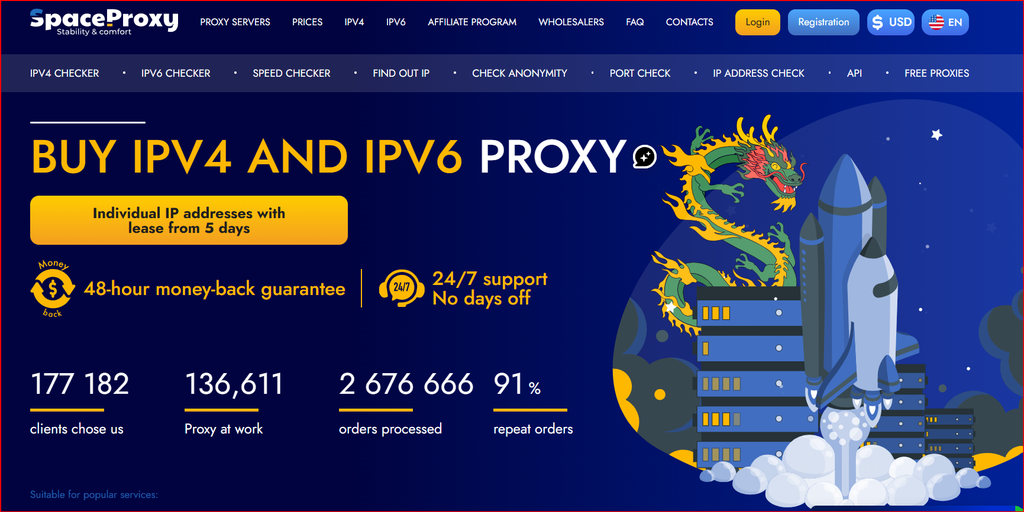
SpaceProxy website screenshot used during this September 2026 review.
Review snapshot
| Category | My review note |
| Best for | SEO collection, automation, high-concurrency proxy workflows, geo testing |
| Core products | Shared IPv4, individual IPv4, IPv6/32, MTProto |
| Standout controls | API, city/subnet selection, up to 2,000 streams, auto-renewal |
| Important caveat | Provider speed/network claims were reviewed, not independently stress-tested |
How I reviewed the service
I reviewed the current public product pages, pricing information, setup and configuration choices, support/refund language, and the operational controls a real customer sees before and after purchase. I separate published provider specifications from observations about workflow design. I do not present provider marketing claims as independent benchmark results, and I do not infer long-term uptime from a short review window.
Why SpaceProxy stands out from a basic proxy storefront
The useful part of SpaceProxy is the number of operational controls exposed to the customer. The service lists manual IP selection, subnet selection and city selection, along with a multi-functional API and a personal account. That combination matters for teams that manage pools rather than single addresses. A proxy business becomes much easier to operate when you can intentionally diversify subnets, automate renewals and replace problem addresses without rebuilding the whole workflow.
SpaceProxy also advertises unlimited traffic and as many as 2,000 streams. I would not interpret that as a guarantee that every target website will accept thousands of simultaneous connections; destination-side rate limits still apply. The value is that the proxy product itself is not designed around a tiny connection allowance that immediately becomes a bottleneck.
Pricing and the shared-versus-private decision
SpaceProxy’s pricing is straightforward and closely tied to rental length and product type. Shared IPv4 has the lowest monthly cost, private IPv4 costs more for exclusivity, and IPv6/32 is substantially cheaper. For one to twenty private IPv4 addresses, the published thirty-day price is $1.77 per IP. That is low enough to test a multi-location workflow without a large upfront commitment.
The main buying decision is not ‘which is cheapest?’ but ‘which reputation model does my workflow require?’ A shared proxy can be perfectly adequate for low-risk browsing or testing, but another user can influence the address reputation. For persistent sessions, automation accounts or repeat regional checks, I prefer private IPv4 because it reduces one source of uncertainty.
You can confirm the latest numbers on the SpaceProxy pricing page before ordering, because rates and availability can change.
Current pricing snapshot
| Plan / quantity | 5 days | 30 days | 90 days | 360 days |
| Shared IPv4, 1-20 IPs | $0.67/IP | $0.99/IP | $2.97/IP | $11.88/IP |
| Private IPv4, 1-20 IPs | $0.96/IP | $1.77/IP | $5.31/IP | $21.24/IP |
| IPv6/32, 1-99 IPs | $0.10/IP | $0.51/IP | $1.53/IP | $6.12/IP |
| MTProto, 1-20 IPs | $0.96/IP | $1.77/IP | $5.31/IP | $21.24/IP |
API and repeatable operations
SpaceProxy promotes a multi-functional API, which is important for teams moving beyond manual copy-and-paste configuration. An API can turn proxy inventory into infrastructure: scripts can query orders, synchronize pools with internal tools, or rotate assignments without requiring an operator to log into a dashboard for every change.
The right way to use that capability is to separate purchasing logic from application logic. I would keep a central inventory of active proxies and let internal tools request an address based on geography, project and status. That is more maintainable than hard-coding proxy strings into dozens of scripts.
Subnet and city selection: the feature that improves testing quality
Manual subnet and city selection is valuable for localization work because country-level targeting can be too coarse. A site may show different offers, search results or redirects between cities in the same country. When the provider lets you select more precisely, you can design a test matrix that mirrors the actual regions you care about instead of accepting random country-wide coverage.
Subnet selection also helps with pool hygiene. If ten addresses all come from the same narrow network block, they may behave like one concentrated source from the target’s perspective. Diversifying across subnets does not guarantee acceptance, but it gives the operator more control over network concentration.
Refund and replacement rules deserve attention
SpaceProxy advertises a 48-hour refund or exchange window. Its FAQ adds useful detail: it says there can be no more than five replacements/returns and that traffic usage must not exceed 500 MB for the refund/exchange condition described there. This is exactly the kind of term that should be understood before running a large test immediately after purchase.
My preferred process is to validate authentication, target reachability and geo accuracy on a few addresses first. If something is wrong, stop the test and contact support while usage is still low. That protects the buyer’s options and produces cleaner troubleshooting evidence than burning through traffic before reporting the issue.
IPv6: great economics, narrower compatibility
The price difference between IPv6/32 and IPv4 is large enough to be tempting. SpaceProxy’s own FAQ warns that IPv6 compatibility is limited and that IPv6 can be less reliable for many targets. That is a refreshingly practical warning. IPv6 can be useful for workloads that explicitly support it, but it should not be treated as a universal substitute for IPv4 simply because the unit price is lower.
For a production project, I would test the exact target list with a small IPv6 sample before scaling. If even a portion of the workflow falls back to IPv4-only services, maintaining two parallel proxy stacks may erase part of the apparent savings.
Support, renewals and daily operations
SpaceProxy states that proxies activate immediately after payment, that technical support operates every day, and that IPs can be added or removed during renewal. Auto-renewal is available as well. These are operationally useful features because proxy management is often more about avoiding interruptions than chasing tiny price differences.
I also like that the service allows orders from one IP and rental periods from five days. That makes controlled testing practical. A five-day validation period is long enough to check compatibility across multiple targets without committing to a year.
Final verdict
SpaceProxy offers a strong combination of low pricing and operator controls. The platform is most compelling when you actually use the API, subnet diversity, city selection and short rental periods rather than treating it as a commodity IP shop. The published 1,900+ networks/subnets and 2,000-stream allowance suggest that the service is designed for scale, although those figures should be tested against your own workload.
For 2026, I see SpaceProxy as a good fit for SEO teams, data collection, geo testing and automation operators who want to start with a small pool and scale systematically. My buying preference would be private IPv4 for critical workflows, shared IPv4 for low-risk testing, and IPv6 only after compatibility has been proven.
Pros and cons at a glance
| Pros | Limitations |
| • Low prices and short rental terms | • IPv6 compatibility is limited on many targets |
| • API + city/subnet selection | • Refund rules include usage/replacement conditions |
| • Up to 2,000 streams advertised | • Concurrency still depends on destination limits |
| • Private and shared IPv4 options | |
| • Clear refund/exchange FAQ |
Who I think should consider it
SpaceProxy fits teams that care about automation and concurrency: SEO collection, geo testing, monitoring and internal tools that benefit from an API-managed inventory. Private IPv4 is the safest default for critical work, while shared IPv4 is better treated as a budget test tier.
Frequently asked questions
Does SpaceProxy support both HTTP and SOCKS5?
Yes. The service publishes support for proxy formats used by common HTTP and SOCKS5 clients.
How many streams are allowed?
SpaceProxy advertises up to 2,000 streams with unlimited traffic. Target websites may impose their own limits.
Can I choose a city or subnet?
Yes. The service lists manual IP, subnet and city selection.
What is the refund window?
The site advertises 48 hours. The FAQ also mentions limits on replacements/returns and traffic usage, so read the current terms before testing heavily.
Is IPv6 a good replacement for IPv4?
Only when the target supports it well. SpaceProxy itself notes that IPv6 compatibility and reliability can be more limited.
Bottom line
For buyers who understand the difference between proxy types and validate their target before scaling, SpaceProxy offers a strong mix of price, control and practical workflow features in 2026.
Pricing and specifications checked in September 2026. Providers can change plans, limits, locations and terms; verify the current checkout page before purchase.