IWIHOST is easier to evaluate than many VPS brands because the service publishes a fairly detailed technical stack: KVM virtualization, NVMe storage, ECC memory, dedicated IPv4, root access, DDoS filtering and a broad location footprint. For this 2026 review I focused on whether those pieces form a coherent hosting product, how the entry plans scale, what operational features are included, and where the fine print changes between locations.
My approach was to review the deployment and management workflow rather than pretend a short test can prove infrastructure quality for an entire year. I checked current plan pages, location-specific bandwidth terms, backup and migration claims, provisioning details and support promises. I did not run a multi-month uptime probe, so uptime and response-time figures are identified as provider commitments rather than independently audited measurements.
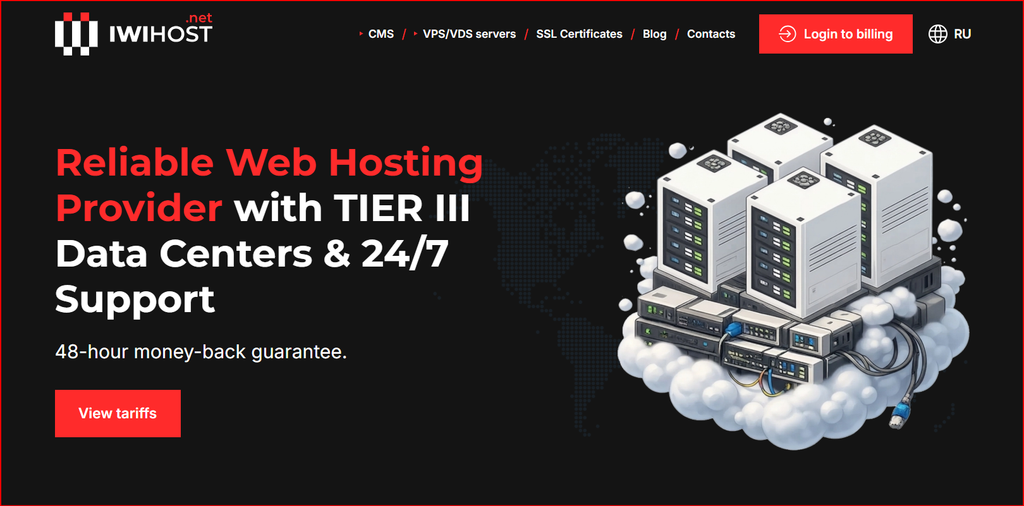
IWIHOST website screenshot used during this September 2026 review.
Review snapshot
| Category | My review note |
| Best for | Linux VPS, websites, development stacks, Docker, databases and self-hosted tools |
| Infrastructure | KVM, NVMe, ECC RAM, dedicated IPv4, Tier III+ facilities |
| Operations | DDoS filtering, automated backups, root access, free migration, 24/7 support |
| Important caveat | Bandwidth allowances can vary by location; verify the selected region before ordering |
How I reviewed the service
I reviewed the current public product pages, pricing information, setup and configuration choices, support/refund language, and the operational controls a real customer sees before and after purchase. I separate published provider specifications from observations about workflow design. I do not present provider marketing claims as independent benchmark results, and I do not infer long-term uptime from a short review window.
A VPS stack that gets the fundamentals right
The technical foundation is conventional in a good way. IWIHOST uses full KVM virtualization, which gives each VPS its own isolated kernel and supports both Linux and Windows on higher plans. NVMe storage is standard, ECC memory is listed across the range, and each server includes a dedicated IPv4 address. For developers and system administrators, that means fewer compromises than container-style budget hosting where kernel-level control is restricted.
Full root and SSH access also matters because the service is not locking customers into a narrow managed-hosting template. You can run a web stack, Docker, a database, a VPN, monitoring agents or self-hosted business tools. The trade-off is responsibility: root access is powerful, but security patching, firewall rules and application hardening remain the customer’s job unless additional management is purchased or arranged.
Pricing: a sensible progression from small to serious workloads
The current Germany page is a useful representative example. Core starts at $4.99 per month with 1 vCPU, 1 GB ECC RAM and 10 GB NVMe. Shield increases to 2 vCPU, 2 GB RAM and 30 GB NVMe for $6.99. Armor brings 4 GB RAM and 50 GB NVMe for $8.99, while Bastion moves to 4 vCPU and 8 GB RAM at $14.99.
What I like about the ladder is that the price increments roughly match meaningful resource jumps. There is no need to leap from a tiny starter server directly into an expensive enterprise tier. For WordPress, a small API or a private service, Shield or Armor is a more realistic starting point than Core because 1 GB RAM leaves limited headroom after the OS and database are loaded.
For another independent publishing reference, see this IWIHOST.net review on HostAndProxy.
Current pricing snapshot
| Plan | vCPU | RAM | NVMe | Representative Germany price |
| Core | 1 | 1 GB | 10 GB | $4.99/mo |
| Shield | 2 | 2 GB | 30 GB | $6.99/mo |
| Armor | 2 | 4 GB | 50 GB | $8.99/mo |
| Bastion | 4 | 8 GB | 70 GB | $14.99/mo |
| Stronghold | 6 | 12 GB | 90 GB | $21.99/mo |
| Fortress | 8 | 16 GB | 150 GB | $29.99/mo |
Network and bandwidth: check the location-specific page
A high-quality VPS review should not flatten every location into one specification. IWIHOST’s Germany page currently says the 500 Mbit/s port applies for the first 20 TB of monthly data before speed drops to 100 Mbit/s. The USA page lists 30 TB before the same reduction. That difference is important: the plan name alone does not tell the entire network policy.
The practical lesson is to choose the country first, then read that country’s plan page before ordering. This is especially important for backup servers, media delivery, crawlers or other traffic-heavy workloads. For a normal website or development environment, the allowance is generous; for sustained high-volume transfer, the exact location policy becomes a core buying criterion.
Backups, DDoS protection and migration
IWIHOST says automated backups are stored on physically isolated backup arrays rather than on the same hypervisor node. That is a better design than local snapshots alone because a host-node failure should not remove both the running VM and its recovery point. I would still keep an off-provider backup for critical data; a provider backup is a recovery layer, not a complete disaster-recovery strategy.
The VPS pages also include L3/L4 DDoS mitigation and free migration from another host. These are valuable operational extras because they reduce the amount of setup work around the server. DDoS filtering does not replace application-layer protection, and free migration should be scoped carefully for complex systems, but both are meaningful inclusions at this price level.
Provisioning and support
The Germany page states automatic provisioning in roughly three to five minutes after payment, while other IWIHOST marketing pages mention activation within around ten minutes. Either way, the service is designed for automated deployment rather than manual queue-based activation. Root credentials are then delivered so the customer can begin configuration immediately.
IWIHOST advertises 24/7 support with average response times under 15 minutes and says requests are handled by system administrators. I treat that as a provider claim, not a measured SLA in this review. The useful point is that the support model is positioned as technical rather than purely billing-focused, which is what VPS customers need when networking or boot issues occur.
Location footprint and who benefits from it
The company advertises a network spanning roughly 40 countries, with clearly published pages for major locations such as the USA, Canada, Germany, France, the Netherlands, Switzerland, Spain, Bulgaria and others. A broad location catalog is most useful when the workload has a latency, data-locality or customer-proximity requirement rather than when the buyer simply wants ‘a server somewhere.’
For multi-region projects, I would standardize on the same base image, firewall policy and monitoring stack across locations. The value of many regions disappears if every server is configured manually and drifts over time. Infrastructure-as-code and reproducible deployment make the geographic footprint much more useful.
What I would improve or verify before purchase
The first item is location-specific bandwidth, because it is not identical everywhere. The second is backup scope: buyers should confirm retention depth and restore workflow for the chosen plan. The third is software licensing. Linux distributions are straightforward, while Windows or commercial control panels may change the effective monthly cost.
I would also like a single comparison page that shows the exact same plan across locations with bandwidth and provisioning differences side by side. The information exists, but a buyer currently has to inspect individual region pages to catch the nuances.
Final verdict
IWIHOST offers a strong value proposition for users who want genuine VPS control without paying managed-cloud prices. KVM, NVMe, ECC RAM, dedicated IPv4, root access, DDoS filtering, backups and a wide location footprint form a solid technical base. The entry pricing is aggressive, and the middle tiers provide enough RAM and storage for real websites and application stacks.
The key to buying well is to select the workload and location together. I would choose Armor or Bastion for most production web applications, verify the bandwidth policy on the exact country page, keep an independent backup, and then scale resources through the panel as usage grows. With that approach, IWIHOST is one of the more practical budget-to-midrange VPS options I reviewed in 2026.
Pros and cons at a glance
| Pros | Limitations |
| • Full KVM and root access | • Bandwidth policy can differ by region |
| • NVMe + ECC RAM | • Entry Core plan is tight for production apps |
| • Dedicated IPv4 and DDoS filtering | • Control panel/Windows licensing may affect total cost |
| • Broad location footprint | |
| • Backups and free migration |
Who I think should consider it
IWIHOST is best for users who want low-cost VPS infrastructure but still need real virtualization, root control and location choice. Developers, small SaaS projects, websites, self-hosted services and staging environments are the clearest fit. Teams that need managed operations should budget for their own administration process or additional help.
Frequently asked questions
Does IWIHOST use KVM?
Yes. Current VPS pages describe full KVM virtualization.
What storage does IWIHOST use?
The VPS range is advertised with enterprise NVMe storage and ECC memory.
Is a dedicated IPv4 included?
Current location pages state that VPS plans include a dedicated IPv4 address.
Does bandwidth vary by country?
Yes. For example, the Germany page lists 20 TB at 500 Mbit/s before a reduction, while the USA page lists 30 TB. Check the exact region.
Are backups included?
IWIHOST advertises automated backups stored on separate backup arrays. Confirm retention and restore terms for your plan.
Bottom line
For buyers who want a budget VPS with real KVM isolation, NVMe storage, location choice and root control, IWIHOST is a credible option in 2026. The strongest buying strategy is to choose the location and workload together, confirm the region-specific bandwidth policy, and use independent backups for anything important.
Pricing and specifications checked in September 2026. Providers can change plans, limits, locations and terms; verify the current checkout page before purchase.