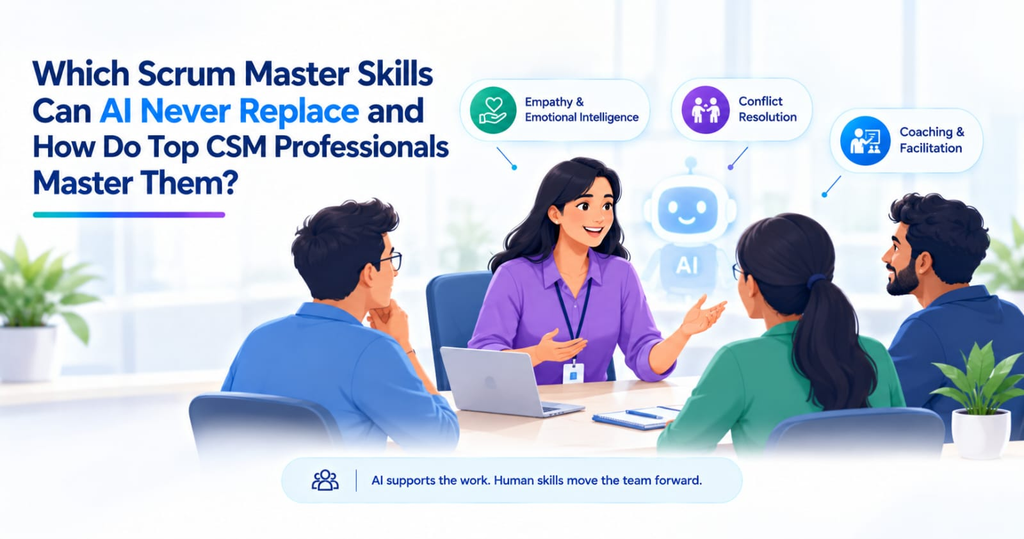
Meta description: Which Scrum Master skills can AI never replace? Learn the human skills that matter most and how top CSM professionals build them.
AI can now write sprint summaries, flag blocked tickets, and draft retrospective notes before a team’s sprint review begins. This brings up an uncomfortable question for individuals developing careers in Agile: what will be left of the job of Scrum Master to justify hiring them?
Human skills are what make up the answer. This article is about the Scrum Master skills that will never be replaced by AI and the ways that the best CSM professionals (Certified Scrum Masters) develop those skills through intentional practice, rather than simply earning a certificate.
Why Human Judgment Still Matters in Agile Teams
The AI has a strong ability to recognize patterns. The AI could inform the team of a decline in velocity of 20% during the last three sprints.
What scrum cannot do is provide answers as to why things occur. It may be that a key developer has been actively looking for another position. It may also be possible that a new stakeholder continues to submit urgent requests via side channels. The reasons for both these occurrences lie within the context of relationships; Scrum Masters spend much of their time working with team members on developing strong relationships.
Professionals at the top use AI as a tool for asking questions rather than getting answers. If a dashboard shows that something has changed, the Scrum Master will go out and speak with other team members.
Empathy and Reading the Room
Imagine a retrospective where all participants agreed that their sprint was “satisfactory.” A developer is staring at the table. Although there are transcripts of what was said during the meeting, there is no record of the long pauses.
When a scrum master notices those types of signals, he/she will follow up with the person(s) who raised them during a private conversation: “Is there anything about this sprint that you didn’t feel comfortable bringing forward?” That single question can usually uncover what the real issue is.
Top practitioners build this skill by:
- Holding regular one-on-one check-ins, even short ones
- Noticing who speaks, who goes quiet, and when
- Asking open questions, then waiting through the silence
Facilitation That Leads to Decisions
Anyone can make an appointment. Facilitating a group of individuals who have varying goals and priorities and helping them to reach a definitive decision before leaving is what facilitation is all about.
Let’s say we have a planning meeting with two very experienced engineers who disagree with each other regarding what type of architecture to use. All of the other engineers at the meeting remain quiet. At this point, a good facilitator would help slow down the discussion, ask each engineer to discuss the advantages and disadvantages of their proposed architecture, and then help the group decide how they want to make the final decision.
Many professionals use various types of formats (silent brainstorming, dot voting, and timed debate) to improve their skills in this area. Many will also have a trusted colleague attend one of their sessions to provide honest feedback.
Influence Without Authority
The Scrum Master cannot terminate an employee or establish their pay. However, the position is frequently required to persuade management (directors), product owners (leaders), and other departments to alter their operational procedures.
Suppose a team is blocked; the other department will take 3 weeks to authorize changes. AI can demonstrate the delay. AI cannot create the trust required to negotiate for an expedited approval process.
Top CSM professionals earn influence by:
- Bringing data and a clear business impact, not complaints
- Building relationships before a problem appears
- Following through on small promises so people take the big asks seriously
Professionals in larger companies who are adding scaled frameworks to their toolboxes because they have to coordinate several teams each day should look into taking an SSM Certification Training course. In addition to learning about how Scrum Masters function across multiple teams, the certification will also provide insight into how to use Scrum in a larger company setting.
Ethical Judgment and Responsible AI Use
Someone must inquire as to if the customer’s sensitive data is being used within a non-approved program. Someone must investigate an AI estimate that doesn’t consider a vulnerable legacy system.
The Scrum Master is usually responsible for this. He/she needs to have a sense of judgement and courage and be willing to say, “We should verify this first,” before taking action. Software doesn’t hold itself responsible.
Strong practitioners understand the limitations of the tools being used by their team, establish clear working agreements regarding AI use, and allow for human decision-making at all times.
How Top CSM Professionals Build These Skills
Mastery seldom comes from reading only. The following habits are often found in respected practitioners.
- Deliberate Practice: Use each Retro and Planning Session as an opportunity to implement one new skill.
- Peer learning: Participating in Scrum communities and comparing your experiences to those of other Scrum Masters
- Reflection: keeping a short log of what worked, what flopped, and why
- Mentorship: learning from a coach who has handled messier situations
- Structured Training: Building on a solid foundation of Scrum principles, then adding to those principles through practical application.
When starting out, formal training provides the same language and practical tools to try on real teams. If you’re ready to make this move, advance skills, get your CSM certification, and use what you’ve learned in live sprints.
Skills Scrum Masters Need to Succeed in 2026
The core set looks like this:
- Coaching: helping teams find answers instead of handing them out
- Emotional intelligence: understanding what people feel, not just what they say
- Conflict resolution: addressing tension early and fairly
- Critical thinking: questioning data, including AI-generated data
- AI Literacy: knowing what the tools are good at, where the tools fall short, and how to double-check their results.
- Stakeholder communication: explaining trade-offs in plain language
The majority of this list relates to humans. While technical knowledge is valuable, the difference between average and exceptional Scrum Masters lies within their ability to utilize their people skills.
Conclusion: Build the Skills AI Cannot Copy
AI cannot replace the Scrum Master’s ability to show empathy toward his/her team members, facilitate meetings, influence others, and exercise good ethical judgment. These abilities develop through on-the-job experience, feedback from team members and other stakeholders, and practice.
The point is clear: let AI handle your administrative tasks so you can use the extra time to engage with clients through conversation, coaching, and building trust. Those professionals who use their extra time in this manner will always remain relevant regardless of what advances occur in technology.